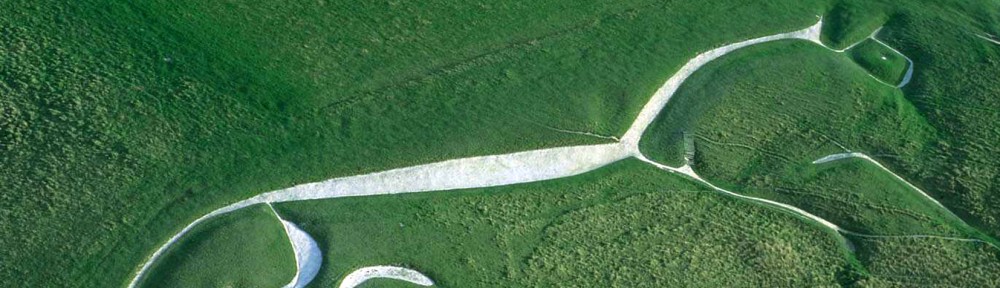
Robert Burns, horseman

On the 25th January, all over the world people celebrate the life and work of Scotland’s famous poet, Robert Burns. Over 200 years after his death in his 37th year, Burns has a mighty and devoted following. At Burns Night suppers, whisky will be drunk and the “Great Chieftain o’ the puddin’-race”, the haggis, will be addressed and subsequently devoured. There will be more toasts, recitation and songs. Poet, exciseman, lover of the lassies and drinking with his cronies, ploughman, toast of Edinburgh, politician, social commentator, creator of scurrilous jibes, observer of nature and animals, mocker of the haughty, collector and writer of songs; this goes a small way towards describing Robert Burns. Every aspect of his life is still open to dispute and discussion.

Of one thing I’m certain, though: Robert Burns was a horseman.

“His grey mare, Meg”

Horses are the subjects of several of his poems and they were a significant part of his life. To take Tam o’Shanter as a starting point for this theme, where would the poem be without Tam’s grey mare Maggie? The poem opens with Tam enjoying an evening’s drinking in Ayr, whilst the weather worsens

The storm without might rair and rustle,
Tam did na mind the storm a whistle..

It’s time he left for home, but the company is good and so are the ales. Tam will drink along with anyone, the miller, his bosom buddy Souter (Cobbler) Johnnie, or the blacksmith, with whom on market days he matches a drink for every shoe:

That every naig was ca’d a shoe on,
The smith and thee gat roaring fou on.

But, finally, reluctantly, Tam has to leave. He goes out into a night of violent storm:

Weel mounted on his gray mare, Meg–
A better never lifted leg–
Tam skelpit on thro’ dub and mire;
Despisin’ wind and rain and fire.

When they pass Alloway Church, Maggie, like her rider, is astonished to see blazing lights and hear the sounds of a riotous party going on:

But Maggie stood, right sair astonish’d,
Till, by the heel and hand admonish’d,
She ventured forward on the light;
And, vow! Tam saw an unco sight…
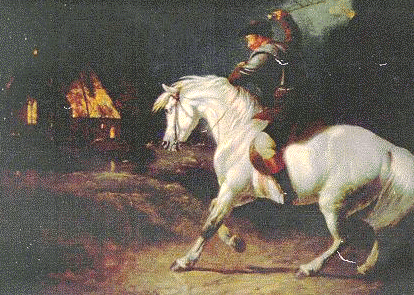
"But Maggie stood, right sair astonish'd, Till, by the heel and hand admonish'd, She ventured forward on the light; And, vow! Tam saw an unco sight..." Tam and Maggie as imagined by Abraham Cooper

The church is full of witches and warlocks having a dance. “Nae cotillion brent-new frae France,” comments Burns dryly, “But hornpipes, jigs, strathspeys, and reels, put life and mettle in their heels.” When the witches strip down to their shifts, both Tam and the Devil (Deil), who is of course presiding over events, are most impressed by one of them, young Nannie. That’s Tam’s undoing. Full of whisky courage, he bawls out “Weel done, Cutty-sark!” as she dances about in a very short shift indeed.

Remember Tam’s mare!

Luckily, his mare Maggie has some sense (and witches aside, the incidence of people getting home safely because of the intelligence of their horses is a regular theme in fact as well as in fiction and poetry). She takes off as though hell is at her heels, which it is, very shortly afterwards:

So Maggie runs, the witches follow,
Wi’ mony an eldritch skriech and hollo.
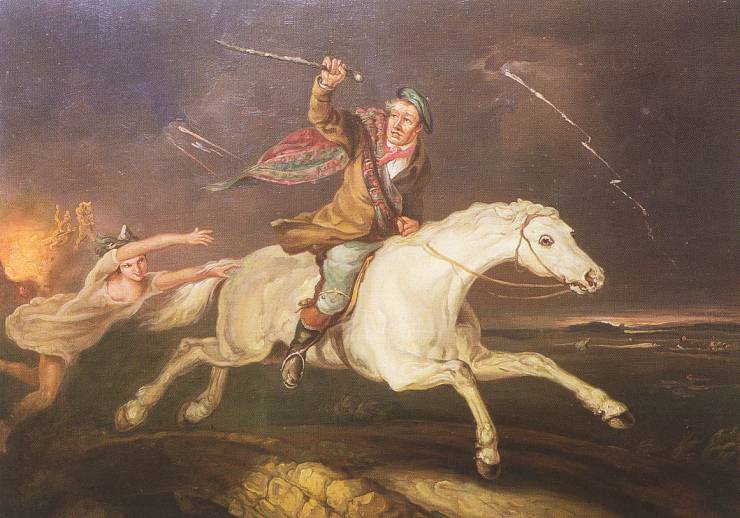
"For Nannie, far before the rest, Hard upon noble Maggie prest"; as imagined by John Joseph Barker

Maggie and Tam are running for their lives towards a stream, which they both know no witch will cross. And with a last desperate bound, Maggie is just carrying her master to safety when the witch Nannie grabs at her tail and:

For Nannie, far before the rest,
Hard upon noble Maggie prest,
And flew at Tam wi’ furious ettle;
But little wist she Maggie’s mettle –
Ae spring brought off her master hale,
But left behind her ain gray tail;
The carlin claught her by the rump,
And left poor Maggie scarce a stump..

So, suggests Burns, the next time you’re distracted by whisky, ale or short shifts: “Think! ye may buy joys o’er dear – Remember Tam o’ Shanter’s mare.

Burns was lauded in his own lifetime but financially he was constantly struggling. When working as an exciseman, for instance, he wrote to a close friend:

I know not how the word exciseman, or still more opprobrious, gauger, will sound in your ears. I too have seen the day when my auditory nerves would have felt very delicately on this subject; but a wife and children are things which have a wonderful power in blunting these kind of sensations. Fifty pounds a year for life, and a provision for widows and orphans, you will allow is no bad settlement for a poet.

Poor jaded Pegasus

It was whilst working as an exciseman that Burns rode many a mile throughout south west Scotland, finding himself in the middle of a cold winter at remote Wanlockhead with his horse in need of calkins to improve the grip on the frosty road. When the local smith would not come out to shoe Burns’ horse, which was his favourite, Pegasus, Burns hastily penned a poem to be presented to a local worthy who arranged to have the work done. The use of classical imagery is of course quite usual, but it’s possible there’s some deeper message in it:

With Pegasus upon a day
Apollo, weary flying,
(Thro’ frosty hills the journey lay)
On foot the way was plying.

Poor, slipshod, giddy Pegasus
Was, but a sorry walker,
To Vulcan then Apollo gaes,
To get a frosty calker.

Obliging Vulcan fell to wark,
Threw by his coat and bonnet;
And did Sol’s business in a crack,
Sol pay’d him with a sonnet.

Ye Vulcan’s Sons of Wanlockhead,
Pity my sad disaster;
My Pegasus is poorly shod,
I’ll pay you like my Master.

One another occasion, Burns and Pegasus were settled at “the only tolerable inn”, Bailie Whigham’s in Sanquhar whilst a “grim evening and howling wind were ushering in a night of snow and drift,” as Burns wrote to a friend. In this letter it’s clear how much he relates to the horse as a comrade, not just a convenience for carrying out his work:

My horse and I were much both fatigued by the labors of the day, and just as my friend the Bailie and I were bidding defiance over a smoking bowl, in wheels the funeral pageantry of the late great Mrs Oswald and poor I am forced to brave all the horrors of the tempestuous night, and jade my horse, my young favorite horse, whom I had just christened Pegasus, twelve miles further on, through the wildest moors and hills of Ayrshire, to New Cumnock…

Burns penned a bitter ode to the unpopular old woman whose corpse had caused him leave the comfortable inn and to “jade” his horse.

The Ploughman Poet

Much capital was – and is – made of Burns as the “Ploughman Poet”. For many, this conjures up the classic image of the ploughman with his team, working the land steadily with, perhaps a flock of birds following on behind feasting on the worms turned up by the ploughshare. The reality was rather different.

Firstly, the literati of Edinburgh (and beyond) were fond of creating romantic images around creative talents coming from a rural background – as with James Hogg, “The Ettrick Shepherd”. Hogg was a shepherd and Burns was a ploughman, but the use of these terms as a convenient marketing tag has to be separated from the reality of the sheer hard labour involved. During Burns’ lifetime, there were major developments taking place in both agricultural equipment and methods. Scotland was at the forefront of these changes and the new two-horse plough was – apologies – cutting edge technology.

Whilst some Mediaeval and Renaissance images, particularly from Europe, show ploughs being drawn by a pair of horses, this still wasn’t the norm in Britain. Ploughing using the “primitive plough” was mostly done by oxen – this continued in some very rural parts late into the 19th century – and it took four or more oxen, sometimes augmented by horses, to drag the plough through the earth. Sometimes four horses would be used instead of oxen. It was also a communal effort, requiring a family or a ploughman and several labourers. Stones and weeds had to be cleared as it went along and it usually took two men at least to manage the plough, one to hold the hilts, or stilts (handles) and the other to apply weight so it cut through the ground. Someone had to lead or goad the team as well.

All that changed when James Small designed a new type of plough in the second half of the 18th century. That, along with the development of the Clydesdale in Scotland and the Shire in England, resulted in a revolution in ploughing that would lead to the heavy horse becoming the centre of farming life – but that’s a whole story on its own. What Burns understood by ploughing was the old form, not the new that was coming into being. Alistair Moffat, in his excellent book The Borders, writes:

The most famous ploughman who ever lived, Robert Burns, owned a copy of James Small’s treatise, but he never made use of it. Working alone in an outbye field with only his horses for company was not a prospect Burns ever relished. For him, the body warmth, the crack and the shared experience was a necessary part of the hard, hard work of farming.”

The life of a ploughman

As I was a-wand’ring ae morning in spring,
I heard a young ploughman sae sweetly to sing;
And as he was singin’, thir words he did say,—
There’s nae life like the ploughman’s in the month o’ sweet May.

The lav’rock in the morning she’ll rise frae her nest,
And mount i’ the air wi’ the dew on her breast,
And wi’ the merry ploughman she’ll whistle and sing,
And at night she’ll return to her nest back again.

Robert BurnsThe Ploughman’s Life

Salutations to old mare Maggie

For me the best example of Burns as a horseman comes from a lesser known poem, The Auld Farmer’s New-Year Morning Salutation to His Auld Mare Maggie, on Giving Her the Accustomed Ripp of Corn to Hansel in the New Year. A “hansel” is a payment, a gift, or hand grip, often used in betrothal. Here it’s an agreement between the old farmer and his mare, now very old. As he gives her a New Year gift of corn, he reminisces about their lives together, how he inherited her from his father twenty-nine years earlier. Her coat is now white with age but he remembers her when she was young and beautifully dappled:

Tho’ now thou’s dowie, stiff, an’ crazy,
An’ thy auld hide as white’s a daisy, I’ve seen thee dappl’t, sleek and glaizie,
A bonny gray…

His mare brought home his young bride on her back:

That day ye pranc’d wi’ muckle pride,
When ye bure hame my bonnie bride:
An’ sweet an’ gracefu’ she did ride,
Wi’ maiden air!

And Maggie has born him ten foals, some of which are in his plough team whilst others he has sold. In the poem, all his past, all his life is read in her and through her like a book. They have grown old together. Finally he assures her that she will always have a place with him and even of his last bundle of corn, she’d always have a portion, a “heapit stimpart” a generous quarter of a peck:

And think na, my auld, trusty servan’,
That now perhaps thou’s less deservin,
An’ thy auld days may end in starvin,
For my last fow,
A heapit stimpart,
I’ll reserve ane Laid by for you.

He promises to tether her out on a grassy ridge where she can “nobly rax her leather” – stretch her old body out – and rest. “Flit”, which has amongst its meanings “to tether” can also mean to die, to pass over. The sense, the feeling, that I draw from this is that even in death her body will be nobly buried, not cast aside. If you want to read the whole poem, try the Gutenberg Project where you will find the complete version and, indeed, all Burns’ works. http://www.gutenberg.org/files/18500/18500-h/18500-h.htm

So, as you celebrate Burns Night remember Robert Burns the horseman too. Here’s to you, Rabbie! Cheers!
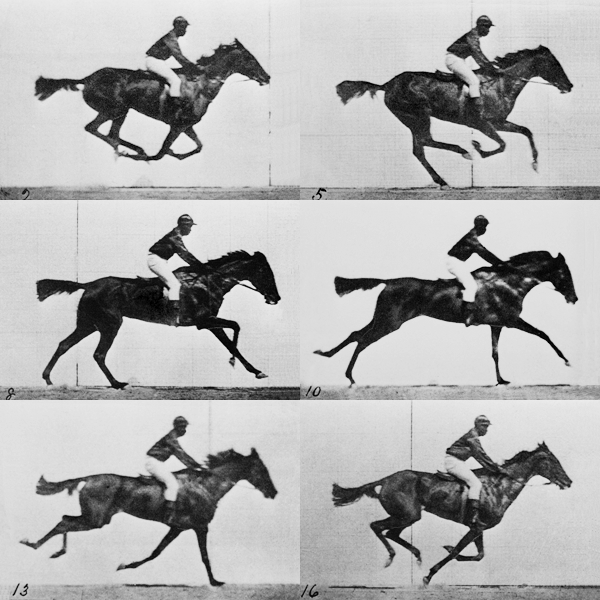
Seeing how they run: horses in early photography and film

Being a historian – and that is anyone with an interest in history – is like being a time traveller. It’s possible to go anywhere you’d like to go in the past and still be back in time for tea. Then you can go off on another journey, to the same place or a different one; and even the same place can be a new destination if you read a number of different interpretations of the past. It’s astonishing how much diversity there is in historical writing and interesting to see how specialist historians choose to focus on different aspects of people, places and activities.

One thing recurs, though; and that is, just how ubiquitous horses, ponies and mules  were before the arrival of the train and the car. That’s obviously the major theme of historyonhorseback, but even I am surprised sometimes when I stumble on an unexpected connection to the horse in an area that I hadn’t previously considered researching.

The start of this journey was a feature in Amateur Photographer, written by David Clark, about the man who formulated the first photographic process: Joseph Nicéphore Niépce.

The oldest photograph in existence – includes a horse!

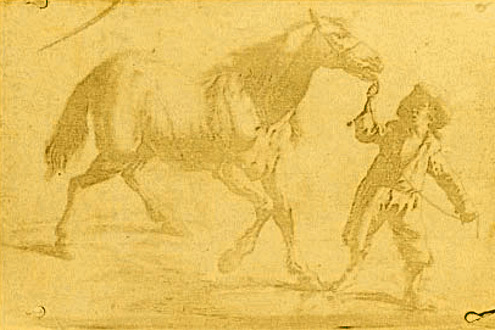
I had never heard of this man but then I’d never claim to be an expert on the history of photography. I certainly knew about Eadweard Muybridge and his contribution to photography and film and the role horses had played in that – which I’ll discuss shortly. But Niépce? Who was he? As I turned the page, an image of a man leading a horse caught my eye. I read the caption: “Niépce’s image of an engraving, depicting a man leading a horse, made in 1825…”

The oldest photograph still in existence: an image of a 17th engraving of horse and man

Yes, that’s right – the earliest photograph still in existence is of a man leading a horse. The reproduction of the engraving, in the pages of AP, showed a warm yellowy-pink background with a faded looking image of horse and man. The man is looking anxiously up at the horse and is holding it tightly on a lead rope with his hand close to its jaw, whilst the horse shows its anxiety by throwing its head up and opening its mouth. Its back is tense and the hindlegs almost crouched in appearance. It looks as though it is jibbing, refusing to go on, possibly even about to rear up. The man is barefoot and gives the impression of being one of the many who hung about inns and houses in the hope of holding someone’s horse for them in return for a tip. He looks as though he’s taken on more than he expected here. Or is he leading up the horse at a horse fair? Or stealing it?

Equestrians will also note that one of the bare feet of the man is very close to the hoof of the horse. Has he perhaps been trodden on, yelped and surprised the horse? It’s a scenario that most of us will have experienced at some point, though not with bare feet, perhaps.

It isn’t a photograph of  a real horse of course, it’s an image of an image, a 17th century engraving. It would be years before photography was capable of capturing motion successfully and so there would never have been any question of Niépce trying out his new invention on a moving animal. This is one of the earliest photographic images ever made and in retrospect perhaps it’s not surprising and also quite touching that it should include a horse.

A golden generation

Joseph Niépce was a remarkable character.  Born in Chalon-sur-Saone in France in 1765, he later adopted the name Nicéphore after a Byzantine bishop and saint, Nicephorus. Niépce was one of a remarkable generation; the revolutionary and post-revolutionary Napoleonic generation that produced so many original scientific thinkers whose legacy still touches our lives on a daily basis, although we may not always be conscious of it.

Niépce began his experiments in producing fixed images using the existing technology of the camera obscura. It was quite usual to trace the images cast by this interesting invention, but Niépce wanted to find a way to fix the images in some sort of permanent medium in a way that didn’t involve tracing. He experimented with silver nitrate but struggled to produce something that didn’t fade until he did further experiments with bitumen and lavender oil.

His first known successes date from the late 18th century although these images deteriorated quickly and nothing remains of them. I do find it fascinating to think that if he had succeeded at this early date, we might have had photographs of Napoleon’s 1798 expedition to Egypt and the “savants” who took part in the world’s first multi-disciplinary scientific investigation. This date also marks the start of the study of ancient Egypt as a separate discipline which is also known as Egyptology. And there is, perhaps, a curious link to Egypt, or at least to the ancient world, in the name Niépce gave his process, which was “Heliography”, or “sun writing”, in recognition of the need for light exposure to produce the image. Helios is of course the name of  a sun deity – often visualised as driving a chariot through the sky – and the ancient Egyptians had numerous forms and expressions for worshipping the manifestations of their own sun god.

In contrast to Niépce, the life of Eadweard Muybridge is generally better known and more widely documented. His life began and ended in Kingston-on-Thames in the UK, but in between those events, it was one hell of a hair-raising ride.

An old mystery resolved

Muybridge was born Edward James Muggeridge in 1830 and so into a world where photography was recently established, growing and evolving. He moved to the USA where he changed his name several times. A stagecoach accident caused him to return to the UK for a while and it was here that he studied photography.  On recovery, he returned to America and worked as a successful photographer, using the name “Helios” for his business and the signature on his prints.

It’s hard to tell how long the discussion about animal motion had been going on. It might have been for centuries. Certainly in the ancient world it was standard practice, when producing images of galloping animals such as horses, to show them in a strange pose called “the flying gallop”: the front and back legs are stretched out somewhat like those of a rocking horse. This strange and inaccurate portrayal persisted right up until the 19th century, arguably reaching its height in the 17th century AD. Attempts to show other paces were slightly more successful, although in some of the ancient images of walking horses, the horses’ feet appear to be stuck to the floor; not one hoof is raised although the legs are bent as though in motion. The correct leg sequence of each of the paces of a horse was strangely hard to portray although it could clearly be felt by any equestrian. And it was the new invention of photography that would finally resolve some very ancient issues regarding movement.

In 1877, Muybridge became involved in the debate when the Californian Governor, Stanford, argued that when a horse was trotting, a two-beat pace where the legs are on the diagonal (that is, the foreleg and hindleg on the same side are alternately together and apart) there was a moment of suspension when all four legs were off the ground. Previously, this had been impossible to prove one way or another.

A horse in the air: but not in the flying gallop (Source: Wikipedia.)

Muybridge managed to get a single photographic shot showing that there was indeed a moment of suspension and this led on to further investigations. He ingeniously came up with ways of recording a sequence of movements, firstly by using threads that triggered photographic shots as the horse broke through each one; these could then be copied and turned rapidly in sequence on a machine called the zoopraxiscope, to recreate the impression of movement. Then, secondly, he developed a more reliable clockwork version to replace the thread process. He was able to demonstrate that in gallop, there is also a point when all four legs are off the ground; this occurs when the legs are drawn together at their closest and the idea of the flying gallop was finally dispelled, in horses at least, although the debate was still alive and well in the 1930s with regard to other animals. The sequence, of one of Stanford’s horses, entitled: “Sally Gardner at a gallop” is still breathtaking to watch.

Fortune’s wheel

It would seem as though Muybridge was destined for fame as the founding father of cinematography with these very early versions of movies; and indeed, he did have a successful career as a lecturer and creator of moving and sequential images. His publication “Animal Location”, with photographic sequences of both human and animal subjects in motion, is still a useful reference for artists, amongst others.

However, as with Niépce, who also had personal and financial issues to drain him, Muybridge’s personal and professional life collapsed into ruin. Eventually he fell into dispute and litigation with Stanford – and lost – but prior to that there was a far greater scandal and tragedy. Muybridge’s wife was having an affair  with an army major, Harry Larkyns and in 1874 Muybridge approached him, spoke briefly to him and then shot him dead. Muybridge was acquitted on the basis of “justifiable homicide” rather than insanity as a result of his earlier head injury, a legal decision that does seem somewhat extraordinary nearly 150 years later.

Niépce and Muybridge; two totally diverse pioneers whose contributions to photography and, in the case of Muybridge, cinematography, are outstanding.  And where those pioneers were, so too were horses.

Amateur Photographer, 24 – 31 December 2011, Icons of Photography: View from the Window at Le Gras pp 50 – 52. Feature by David Clark.

Journal of the American Oriental Society, Vol. 56, No 2 June 1936, pp 178 – 188, Two Notes on the Flying Gallop by William F. Edgerton.

For more about Muybridge: http://www.archives.upenn.edu/primdocs/upt/upt50/upt50m993/upt50m993.html

For more about Niepce, there is a museum devoted to his work: www.niepce.com

Welcome Christmas, welcome the Grey Mare!

Given the long association between equids and humans, it’s not surprising that festivals and rituals involving horses can be found right across the world. One of the most interesting, and possibly of great antiquity, is the Welsh tradition of the Mari Lwyd, or grey mare. It’s also known as Y Fari Lwyd. Although this tradition, like many British and indeed European customs, fell into disuse in the 20th century, it has been revived and is now firmly re-established in parts of Wales.

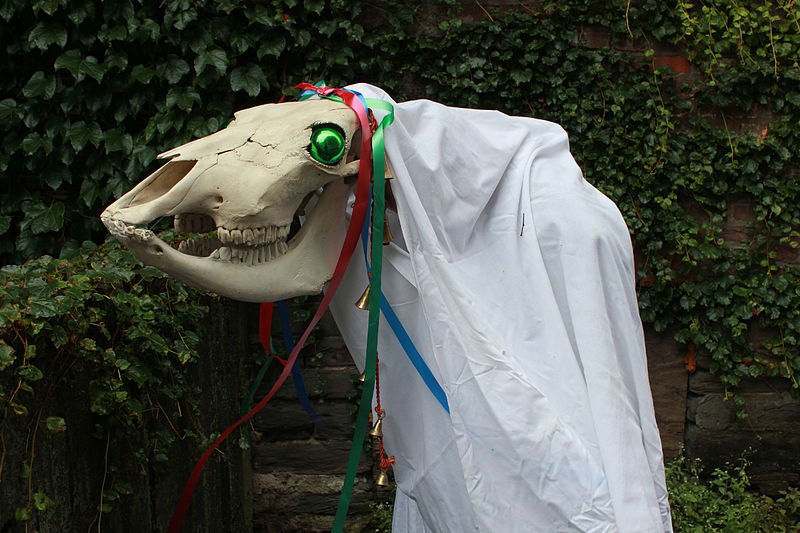
The modern Mari Lwyd, complete with baubles for eyes. Source: http://en.wikipedia.org/wiki/Mari_Lwyd

The Mari is particularly associated with midwinter. The specially prepared and dressed skull of a horse is carried around from door to door (or pub to pub) and at each house the person who carries the Mari, disguised under a sheet, has to sing rhymes to obtain access. In Wales, with its strong Bardic tradition, there’s great skill and wit in constructing complex and entertaining rhymes. The inhabitants of the building must sing back to the Mari, using their own wit and skill to construct replies; and so the ritual becomes a contest of knowledge and ability.

Almost invariably the Mari Lwyd wins. After all, this tradition is very much like that of first-footing in Scotland and the north east of England: the Mari Lwyd and her followers are honoured guests who bring good luck with them.

Share the cake, tap the barrel!

There are various songs that are particularly associated with the Mari Lwyd and as with many ancient, probably pre-Christian, ceremonies, it wasn’t long before the Church decided to stamp it with its own brand by adding a Mari Lwyd carol to the proceedings. You can find the words and a recording of it here: http://www.omniglot.com/songs/bcc/marilwyd.php and there’s another associated song here, at the Museum of Wales: http://www.museumwales.ac.uk/en/1555/?id=2 mari lwyd folk song national museum of wales

If you’ve gone to bed too early
In a vengeful spirit,
Oh, get up again good–naturedly
Tonight.

The large, sweet cake
With all kinds of spices:
O cut generous slices
This Christmas–tide.

O, tap the barrel
And let it flow freely;
Don’t share it meanly
This Christmas–tide.

There are several Youtube videos of the Mari Lwyd ceremonies. Here’s one, that gives a flavour: 2008 Mari lwyd celebration http://www.youtube.com/watch?v=ZZu8lcuEUMY

“Old Ball” and his master, the Lord of Misrule

In Robert Neill’s famous novel about witchcraft in 17th century Lancashire, Mist over Pendle, Margery, a young woman from London, goes to stay with a relative in “the north country”. At Christmas, they travel to another relative’s house to celebrate the 12 days. The celebrations are led by the “Lord of Misrule” and Margery is told that when his horse “Old Ball” comes in, then she must hold on tight to the old horse’s tail:

 “Then, cavorting through the doorway, neighing, kicking, and jumping clear from the floor, came the monstrous image of a horse. The stamping and cheering rose to madness, with shrieks and whistles and bangings of mugs. Margery took one look at Old Ball and then swayed helplessly against her neighbour, hurting her ribs with laughter. Old Ball was a huge horse’s head, crazily done in wood and canvas; the round bottoms of wine-bottles formed his eyes, and his teeth were painted wooden pegs; below, two stout sticks took the weight and pretended to be his front legs; a great sheet of canvas made his body, and concealed the man who was his hind legs and who worked his tail and jaws; for both moved. There was a great tail of red-bound rope, which flapped wildly; and there was a lower jaw which moved creakingly up and down; and from out of this mouth there stuck a great iron ladle, gaily hung with ribbons.”

The crazy creature walks around the room, his jaws opening and closing as he demands money from each member of the party. The money is put into the ladle to begin with and it disappears with a clang. Then people begin to throw coins and the merriment increases as the Lord of Misrule scampers about gathering up the money.

A wild and whirling romp

“Then the climax came. The musicians who had played for the dancing suddenly struck up again, and Old Ball went stamping around the room to the thump of a marching tune. The staid and portly moved hurriedly aside, and the rest rushed wildly at the tail of red-wrapped rope; as many as could get a grip hung fiercely to it and the rest hung as fiercely to them; and soon three-quarters of the company were solemnly tramping a circle in tow of that crazy horse…The solemn tramp became a jogging trot; the trot became an unsteady run; and soon there was a wild and whirling romp, till the man in the canvas horse stumbled and fell headlong. His followers sprawled on top of him, and their followers fell across them in a wild hooting chaos while the music ended abruptly in a screech of discord.” – Robert Neill, Mist over Pendle

Was Old Ball a version of “Old Baal”, as some have suggested, giving not only pre-Christian but possibly middle eastern origins?

The Mari Lwyd is sometimes viewed as part of a wider tradition of hobby horses, not only in Britain but across Europe and beyond, but they all vary greatly suggesting multiple origins for the traditions: http://en.wikipedia.org/wiki/Hobby_horse There’s also a page about the Mari Lwyd specifically: http://en.wikipedia.org/wiki/Mari_Lwyd

A bit more about the Mari can be found at http://www.llgc.org.uk/blog/?p=313  National Library of Wales and there’s a Flickr group for sharing images: http://www.flickr.com/groups/944820@N20/

Nommo and the ancestors

Whilst I was preparing this page, I received a link from the Metropolitan Museum in New York, relating to the Dogon people  of Mari, in Africa, who have their own special midwinter festival relating to a  horse who is the primordial being Nommo in equine form. This tradition, whilst very different from that of the Mari, is very appropriate for this blog as it is linked so closely to the Winter Solstice. This is from the Met site:

“Holding the eight original human ancestors and everything they needed for life on earth, the ark was guided by Nommo, the primordial being who created order within the universe. When the ark settled on the ground, Nommo transformed himself into a horse and transported the eight ancestors across the earth to water, where the ark floated like a boat.In this example, the horse’s head is fitted with a bridle, representing Nommo’s transformation into equine form, while the eight original ancestors are portrayed in two groups of four on the sides of the vessel.”

Read more about it and see the ritual vessel here:  http://www.metmuseum.org/Collections/search-the-collections/50004812

Let’s give the Old Grey Mare the last word: there is a saying, now disused, “The grey mare is the better horse.” In other words, the female in the partnership always outdoes the male. But is it true? Well, only the grey mare knows – and she’s not saying.

A VERY MERRY, HORSEY HISTORY YULETIDE TO YOU!

The other “Warhorse”: Captain’s Story

The recent US launch of the Spielberg film “Warhorse”, based on the hugely successful musical, based in turn on the novel by Michael Morpurgo, reminded me of the first warhorse whose story moved me to tears. It was in that most famous of equine stories, Black Beauty, and when I re-read it recently I found it had lost none of its impact. Anna Sewell wrote her story with intent: she wanted to bring the plight of working horses into public awareness and reduce the mindless cruelty she witnessed all about her, from the fastening up of carriage horses’ heads with the “bearing rein” to the endless beatings and maltreatment of worn out cab horses in London.

The warhorse in question is Captain was once a “dark, dappled iron grey, and considered very handsome” but at the time of the story, like all ageing grey horses, his coat had turned to white. He tells his story to Black Beauty, his harness mate with whom he now draws a cab through the London streets.

“Lifted off our legs”

Captain, known then as Bayard, was a cavalry horse shipped out, with hundreds of others, to serve in the Crimean War; if the term “served” can be justifiably used, because of course in Captain’s case, there was no choice. In order to get the horses onto the ship, canvas slings were placed round their bellies and they were swung into the hold. The practice of transporting horses by sea or water was a very ancient one; the Egyptians of the New Kingdom had successfully transported horses up and down the Nile.  There is a fascinating image from the tomb of one of the relatives of Ramesses II showing two horses being carried in a kind of stable on board the deck of a barge under tow. The impression given is that the horses are looking around in surprise as the river flows slowly past.

Journal of the Crimean

However, for Captain and the other horses that were to serve in the Crimea, crowded conditions and rough seas awaited them on their journey and many died en route.The fact that the horses permitted themselves to be lifted by sling is a measure of the bond they had developed with humans, through the close relationship between cavalryman and horse. A horse that cannot steady itself and stand on its feet is a horse that is vulnerable in the extreme.

Although the horses could not record the horrors of the journey – and how they can have coped with seasickness and the instability of standing on decking, both traumatic circumstances for horses – we do get some idea from the Journal of the Crimean War written by Lord George Paget. This details the truly horrific conditions and refers to at least two horses becoming crazed with “a sort of mad staggers”. The only treatment they received for this was to have water flung over their heads. Those horses that died in transit were simply dumped overboard.

“But what of the fighting?”

Sewell’s book is significant because throughout it we have the horse’s eye view of human activity, whether from the perspective of a relatively well-kept riding horse belonging to the aristocracy, a pony thrashed by an apprentice, a maltreated mare who fights back against human injustice or an old warhorse veteran now ending his days pulling a cab on the streets of London. Captain gives us the truth of what happened, rather than the official view. And it moves us to tears more than any human description.

“But what of the fighting?” asks Beauty, “was that not worse than anything else?”

Captain replies: “I, with my noble master, went into many actions together without a wound; and though I saw horses shot down with bullets, pierced through with lances, and gashed with fearful sabre cuts; though we left them dead on the field, or dying in the agony of their wounds, I don’t think I feared for myself. My master’s cheery voice, as he encouraged his men, made me feel as if he and I could not be killed.”

He continues, “I had cantered over ground slippery with blood, and frequently had to turn aside to avoid trampling on wounded man or horse, but, until one dreadful day, I never felt terror…”

“C’est de la folie!”

The terrible day is, of course, the fateful day of the Charge of the Light Brigade, in which the British light cavalry, consisting of units of Dragoons, Lancers, Hussars and the famous Scots Greys, rode into a charge that ended in them being massacred under gun and cannon fire from three sides. “Someone,” said Tennyson in his famous poem, “had blundered.” This tense understatement has become a byword for incompetence and miscommunication at the highest level. An estimated 500 horses were killed or subsequently destroyed, usually by army farriers who provided the veterinary services to the cavalry at that time.

“C’est magnifique, mais ce n’est pas la guerre,” General Bosquet is reported to have said, but the truth was clear in his other comment – “It’s madness.”

Captain’s story

Let Captain speak for the horses. After talking of the intimate kindness shared with his master just before the charge, he says, “I cannot tell all that happened on that day, but I will tell of the last charge that we made together: it was across a valley right in front of the enemy’s cannon…From the right, from the left, from the front, the shot and shell poured in upon us. Many a brave man went down, many a horse fell, flinging his rider to the earth; many a horse without a rider ran wildly out of the ranks: then, terrified at being alone with no hand to guide him, came pressing in amongst his old companions, to gallop with them to the charge…

“My master, my dear master, was cheering on his comrades with his right arm raised on high, when one of the balls whizzing close to my head, struck him. I felt him stagger with the shock, though he uttered no cry; I tried to check my speed, but the sword dropped from his right hand, the rein fell loose from the left, and sinking backwards from the saddle he fell to the earth; the other riders swept past us, and by the force of their charge I was driven from the spot where he fell…

“I wanted to keep my place by his side, and not leave him…but it was in vain…

“Some of the horses had been so badly wounded that they could scarcely move from the loss of blood; other noble creatures were trying on three legs to rise on their forefeet, when their hind legs had been shattered by shot. Their groans were piteous to hear, and the beseeching look in their eyes as those who escaped passed by, and left them to their fate, I shall never forget…”

Captain was one of the fortunate horses who survived the charge and was returned to England, “but the greater part of the noble, willing creatures that went out that morning, never came back!”

“Do you know what they fought about?”

Captain and Beauty discuss the reasons for the war. Beauty has heard – although one senses that he is just using this to draw out Captain’s views – people talking about war “as if it was a very fine thing.”

Captain considers that “I should think they never saw it. No doubt it is very fine…when it is just exercise, parade and sham-fight…but when thousands of good brave men and horses are killed, or crippled for life, it has a very different look.”

Beauty wants to know whether Captain knew what the fighting was all about.

Captain’s reply is a brilliant example of Sewell’s capacity to put an innocent and trusting statement into the mouth of a horse, and at the same time produce a biting and satirical comment on the folly of humans: ‘No,’ he said, ‘that is more than a horse can understand, but the enemy must have been awfully wicked people, if it was right to go all that way over the sea on purpose to kill them.’

A current exhibition related to the “Warhorse” book and movie is being held at the National Army Museum: http://www.nam.ac.uk/microsites/war-horse/; there’s also some excellent information available at the site of Will Hutchison, author of a novel about the Crimean War:  http://willhutchison.com/blog/2010/01/10/horses-in-the-crimean-war/; there’s  information about the very limited veterinary treatment horses received in this campaign at http://www.ams-museum.org.uk/museum/ravc-history/; the famous charge itself is described here: http://en.wikipedia.org/wiki/Charge_of_the_Light_Brigade;

Feuding, fighting and twenty-two pound tumours: the lives of the “Doctors on Horseback”

“Dysentery has been more deadly than all the cavalry charges of history.” – James Thomas Flexner

“‘Now, John,’ he said, ‘ride for your life – that is, for your mistress’ life; there is a not a moment to lose. Give this note to Dr. White; give your horse a rest at the inn, and be back as soon as you can.'” – Anna Sewell, Black Beauty

“Dear Cecil: I recently acquired a satellite dish and have become a shameless junkie of old westerns. In half of these B movies of plains life, it seems there is always a woman giving birth. After they give her the obligatory wooden spoon to bite on, someone always yells to boil some water. What’s with the water?” Question from Ryan Bailey to Cecil Adams. http://www.straightdope.com/columns/read/1109/when-a-woman-gives-birth-in-westerns-why-do-they-always-boil-water

“…Then a rider appeared over the crest of the slope. He was so tall that his legs almost touched the ground.

‘You’re Dr. McDowell?’

The newcomer nodded. In the gap between his coonskin cap and his fur collar nothing was visible but tiny, brilliant eyes and a huge nose blue with cold…” James Thomas Flexner,  A Backwoods Galahad in Doctors on Horseback

It began, as so many projects do, with an old book. This one was Doctors on Horseback, by James Thomas Flexner and it was published in the late 1930s. The book was a series of brief biographies of the founding fathers of medicine in the USA, some of whom also played prominent roles in politics in parallel with their medical careers. “The early doctors of America fought on two frontiers,” wrote Flexner, “riding the wilderness of a new continent, they explored the mysteries of the human body.”

Bloody litigation

And they fought on other fronts; with each other, with their patients and with their critics. Benjamin Rush (1745-1813), a committed, almost evangelical supporter of blood-letting, fell into litigation with William Cobbett (the author of “Rural Rides” and many other social and political essays), when Cobbett suggested that the blood-letting favoured by Rush killed more patients than it cured. Rush was successful, winning 500 dollars in compensation and Cobbett, who had sailed to the USA as an escape from revolutionary France, left the country and returned to England.

Another famous physician, John Morgan (1735-1789), became director-general of hospitals under the American revolutionary army. His duties were onerous and he loaded himself up with more and more responsibility: “At last some more doctors arrived. Morgan did not even take a day’s holiday; driven by that abnormal energy which pulls men through impossible crises, he galloped to Fort Lee to ask General Greene about supplies for the Hackensack Hospital.”

And fell into long-standing dispute with a former classmate, William Shippen, who, according to Flexner, had been politicking behind the scenes in Philadelphia whilst Morgan was galloping about as a serving doctor on the battlefields as well as building hospitals and collecting and storing drugs and other materials for the wounded. Shippen was destined for success and honours whilst Morgan, who was destined to play the role of scapegoat in the mismanagement of medical matters, was dismissed from his post.

However, called before an investigating committee, the records, notes and affadavits Morgan had amassed resulted in his vindication. He vowed to be avenged on Shippen.  He went to great extremes to achieve this, constantly demanding that Shippen attend hearings. Shippen complained that Morgan “…cited me to attend through the deepest snow this winter, which he first broke for 200 miles, and was once dug out of a snow hill, and was once froze to his saddle…”

Snake-eye

Morgan, who was a founder of the American Philosophical Society, was fascinated by the unusual.  One curious case he cited was that of the “horse with a snake in its eye…not only possessed of mere life but endowed with a very brisk locomotive faculty”, viewing it as a possible example of spontaneous generation. He was sure that it was “a real reptile ‘which from the vivacity and briskness of its motion exceeds any worm and equals that of any kind of serpent I have ever seen.'”

Dr Ephraim McDowell, like Morgan, was a medical student in Edinburgh for a time. In the company of two fellow Kentuckians he began a showy carriage tour of the Highlands in 1793, but “the instant they admitted they were from Kentucky, all formality was thrown aside and the delighted Scots haled them out  on horseback or in a coach and exhibited them….as gentlemen from the extreme backwoods…”

It is as a pioneer of the ovariotomy that McDowell is best remembered. In December 1809 he went to the bedside of one Jane Todd Crawford who was apparently getting towards the end of a tough pregnancy but could not be induced to give birth. McDowell quickly recognised that in fact she had a tumour and that the prognosis was bad. Mrs Crawford agreed to ride the sixty miles to McDowell’s home to undergo a pioneering operation. “The operation would be similar to spaying, and animals recovered from being spayed.”

“Fifteen pounds of dirty, gelatinous substance”

As an aside, spaying of animals had been carried out for many centuries: mares included. Peter Edwards, in “Horse and Man in Early Modern England” cites the example of the “waif mare, Stagg” of Brandsby in the 17th century. However, although there had been a huge amount of discussion regarding the possibility of performing a similar operation on women who were suffering from ovarian tumours, or cysts, until the case of Jane Crawford none had been carried out. Abdominal surgery of any kind was extremely dangerous. Post-operative peritonitis was the biggest fear. However, after Jane Crawford agreed to the agonising ride of sixty miles, in the middle of winter, with her “huge tumour pressed against the pommel of the saddle” (Flexner), a successful operation was performed. “We took out fifteen pounds of a dirty, gelatinous looking substance. After which we cut through the fallopian tube, and extracted the sac, which weighed seven pounds and one half.”

Jane Crawford made an excellent recovery from the operation and lived for over thirty years more. The success of the operation was probably partly due to McDowell’s insistence on cleanliness. However, controversy surrounded McDowell’s techniques and even as she lay on the wooden “operating table,” people were calling for the operation to be ended. Some wanted to hang the doctor.  Afterwards, McDowell’s reputation as a butcher who slit open the stomachs of women would follow him around, despite the success of his technique.

Musty saddle-bags

Medical journals of the early 20th century had poems such as this, honouring the country doctor on horseback who seems to favour the travelling herbalist more than the university trained medical man :

When the whooping cough was ragin’
And the measles were around;
Then he’d mount his rhubarb pony
And go trotting out of town.
With his saddle skirts a-floppin’,
And his leggins all in rags,
And roots and herbs a-stuffin
Out his pussy saddle-bags;

And when mam was down with fever
And we thought that she would die,
That old fellow wouldn’t leave her,
And he never shut an eye.
But he set there like a pilot
For to keep her from the snags,
And he brought her through the riffles
With his musty saddle-bags.”

(Quoted in Medicine in Richmond 1900 – 1975  by Charles M. Caravati, M.D.)

Flexner tells us that Dr. Daniel Drake, of Cincinnati, carried in his saddle bags: “a few instruments and some stock remedies: Glauber’s salts, Dover’s powder, strong paragorics, vermifuges, blisters, Peruvian bark for fevers, dragon’s blood, gamboge, and nux vomica. The ordinary charge was twenty-five cents a mile, one-half being deducted if the horse was fed.”

The only pain killer that McDowell could give Jane Crawford was opium, in pill form. However, things were about to change, for by the time of Jane’s operation, Sir Humphrey Davey’s  suggestion that laughing gas (nitrous oxide) might have a place in surgery was already a decade old. His suggestion took a long time to catch on, though. It was primarily used as a novelty in medical schools where students got off their heads on it (“drunk on the gas”). And, as Flexner relates, “there set out over the land a little horde of chemical lecturers…who depended principally on demonstrations of the drunkenness produced by laughing gas.”

Ether sprees

Flexner describes the arrival of one of these “Lyceum lecturers” in Jefferson, Georgia, home to Dr. Crawford W. Long, in the winter of 1841: “we can visualise his long black beard that terrified the yokels flowing from beneath a broad-brimmed black hat of the type now worn only by Senators. As he rode in his brightly painted cart behind an under-fed nag, he could not have realised that he was making history…”

After watching the results of the lecturer inhaling some of the gas, according to Flexner some of Long’s friends clustered around and joined in. They enjoyed the sensation so much that they begged Long to make some gas for them so they could do it all over again. He was familiar with the use of ether for the same purposes and “ether sprees” became a regular activity. When the young women of the town heard about it and wanted to see what happened, Long saw his chance: “I’ll inhale some if you all promise not to hold me responsible for anything I may do.” Long then went round the room in an ether-fuelled version of “Postman’s knock”.

Eventually Long used the ether for medical purposes when he removed two small growths from a friend’s neck after the patient had inhaled the ether from a towel. He went on to perform more successful operations using the gas. Long made the cardinal error of medical (and academic) practice: he did not publish what he was doing. His seniors warned that it was only a matter of time before one of his patients died. Just as with other doctors, he was castigated and “changed from a hero into an object of terror.” Long had lost the edge and it was others who would take the claim for the use of early anaesthetics in surgery and dentistry.

Whether riding in the country, or in a carriage in town, doctors depended on the horse to do their rounds right into the 20th century. Many a paper was probably written in the minds of the riders and Dr. Masen Good of London translated “Lucretius”  whilst journeying between patients in his carriage (“The Story of Medicine”, Vernon Coleman). Nostradamus and Paracelsus, both 16th physicians whose careers and lives took different paths, must have relied on horses and mules as they travelled about. Without the equids used by all these doctors, how would patients have faired? And yet, as always, we know so little about those animals and what they thought or felt. We’ll leave the last word to Black Beauty, then:

“The doctor came out with his riding-whip.

‘You need not take that, sir,’ said John; ‘Black Beauty will go till he drops. Take care of him, sir, if you can; I should not like any harm to come to him.’

I will not tell you about our way back. The doctor was a heavier man than John, and not so good a rider; however, I did my very best.”

Anna Sewell, Black Beauty.

Simpson and his cuddy

Gallipoli, 25th April 1915. The newly arrived ANZAC troops are about to enter hell. From the moment they attempt a landing on the most inhospitable point of the coast, they are under relentless machine gun and rifle fire from Turkish gunners esconced on the cliffs above. Alan Moorehead, writing in his 1958 publication, “Gallipoli” commented: “…the Gaba Tepe region, where the Anzac troops were to land, was unmapped and almost wholly unknown. It is still the most savage part of the whole peninsula.” Landing to the north of their intended place, eventually over 20,000 men and their horses, mules and donkeys would take shelter in the place that has entered history as ANZAC Cove.

The ANZACs experienced casualties right from the start, many whilst attempting to row to the shore from their troop ships. The dead fell on the shore and in the rowboats; there are varying reports as to the scale of the casualties, but  in the first few hours of the first day alone, it seems that at least half of 1500 men from the first boats were dead or disabled.

The most unlikely and most revered hero of the whole ANZAC Gallipoli Campaign is the man, who, with his donkeys, saved the lives of dozens of soldiers during the first weeks of the campaign, before dying under machine gun fire on 19 May 1915. He was 22 years old. His name is still spoken with reverence in Australia;  the young man was John Simpson Kirkpatrick, better known as Jack Simpson, and he came from South Shields (Shields) in what is now Tyne and Wear, UK.

Simpson’s parents were Scottish and although his father came from Edinburgh, Simpson is a Border name and there is a village of Kirkpatrick Fleming in south west Scotland. It would make sense to me, given the strong cross-border links between Scotland and the north east of England, that Simpson’s parents might have had relatives or friends in the north east if they were Border people. Simpson, growing up in South Shields, was a resident of Tyneside; a Geordie.

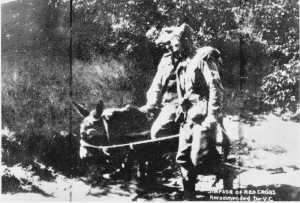
Simpson and his first donkey, probably Duffy, with bandage halter (Australian War Memorials)

He was born in 1892 and, like many children of a large family at that time, his early years were impoverished by today’s standards. Birth rates were high, but so were mortality rates amongst working class people. Families found work where and how they could and one of Simpson’s jobs, according to his biographers, was leading the donkey rides on Shields sands. He’d probably have known them as “cuddies”, which is the word for a donkey that prevails in Northumberland, Durham, Tyneside and parts of Scotland.

So enduring is the legend that has grown around Simpson that it is hard sometimes to separate the facts; however, it seems that he had a genuine way with animals. One detail that will certainly ring true for modern day inhabitants of Tyneside is that his mother affectionately called him “Jackie-ma-lad”.

He joined the Merchant Navy and headed off to Australia; just another young man with his way to make in the world and desire to go to sea, as his father had done. At 17, The life of a stoker must have seemed like a dead end and he effectively deserted on arrival in Australia, to travel around the country, working at various jobs and dropping the Kirkpatrick from his name. He signed up to the army in 1914.

Many of Simpson’s biographers make reference to the fact that, tall strong lad that he was, he was an ideal stretcher-bearer.  That was his allotted task. “Stretcher bearer” suggests some degree of organisation and support but in fact conditions were so chaotic, and casualties so high, that the bearers often had to make a dash under fire to carry the wounded back over their shoulders. Shortly after Simpson’s arrival he found one of the donkeys that had arrived with the water bearers and, with a makeshift halter made from a bandage, took the animal to help him carry the wounded back.

He carried on performing this task, totally independent of any orders, with donkeys variously called Abdul, Murphy, Queen Elizabeth and Duffy, for twenty-four days before he was killed. Duffy is the donkey who has made it into legend as the donkey first found by Simpson. After Simpson’s death, the last of Simpson’s donkeys is said to have returned to the camp hospital on his own, carrying the last wounded soldier Simpson had put onto his back.

The bloke with the donk.

Simpson and his donkey had made it into legend and gained the admiration of the establishment whose rules he had refused to follow.  Australia’s greatest WWI General, then Colonel, John Monash, spoke warmly of him: “Private Simpson and his little beast earned the admiration of everyone at the upper end of the valley. They worked all day and night throughout the whole period since the landing, and the help rendered to the wounded was invaluable. Simpson knew no fear and moved unconcernedly amid shrapnel and rifle fire, steadily carrying out his self-imposed task day by day, and he frequently earned the applause of the personnel for his many fearless rescues of wounded men from areas subject to rifle and shrapnel fire.”

We get a vivid, and believable picture of the character of Jack in the the remembrances of his colleagues in the ambulance brigades, as quoted in Tom Curran’s book, “Not only a hero”: http://www.anzacday.org.au/spirit/hero/chp00.html;http://www.anzacday.org.au/spirit: “Andy described Jack as ‘a big man and very muscular, though aged only 22 and was selected at once as a stretcher bearer… he was too human to be a parade ground soldier, and strongly disliked discipline; though not lazy he shirked the drudgery of “forming fours”, and other irksome military tasks.’ Andy also said of Jack “that ‘he was very witty, and inclined to the lazy, very popular, liked a pot or two but did not drink to excess; careless of dress and was a handful to Sgt. Hookway, his Section Sergeant.'”

And from the same author I get a real sense of the quick flashes of exasperated irascibility and biting wit that were part of his character and in which I also recognise the character of my own Geordie and Border ancestors: “Jack was livid. ‘You stupid lookin’ sod!’, he yelled out – to Private Tom Yeomans – ‘the only chance the poor little bugger hez of gettin’ a bit of a rest and yee hev to ride him back half a mile up this hill.’ Jack could have knocked Yeomans off the donkey’s back, he was so angry (as Yeomans later recalled). ‘Sorry mate’, Yeomans said, ‘I didn’t realise.’ Jack’s anger disappeared as quickly as it had arisen, a summer storm. ‘That’s alreet mate’, he grinned, punching the soldier lightly on the shoulder, ‘Divint dee it again, eh!’

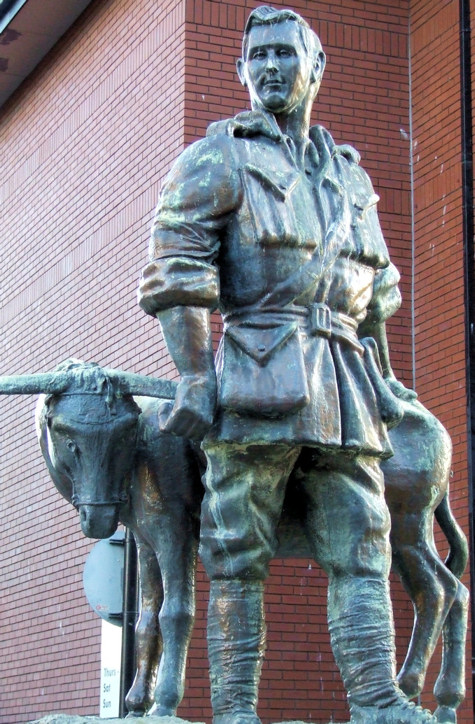
The Simpson Memorial at Shields, Tyneside

As with all legends, Jack Simpson’s story has been told, retold, deconstructed, reconstructed, denied; people question how many casualties he and his donkey could really have carried: the detail, the detail. He has been claimed by many, and by the Australians most of all, who know him as “the bloke with the donk”; “Simpson and his donkey”; “the man with the donkey.” His image has been put onto stamps and statues have been erected to him. He has been described as a humanitarian, a trade unionist and “a disaffected English deserter” who hated guns and who only wanted to return home when he signed up for the army in Perth, Australia.


Who are we to judge? We were not there; we did not witness it. Many historians have written of the utter confusion and mess of the Gallipoli Campaign. The only people with the right to comment, it could be argued, were the casualties saved by “the man with the donkey”. They are the people who experienced the work of this man and made his legend: they were the “diggers” of ANZAC cove and with their ghosts and their living relatives it should remain.

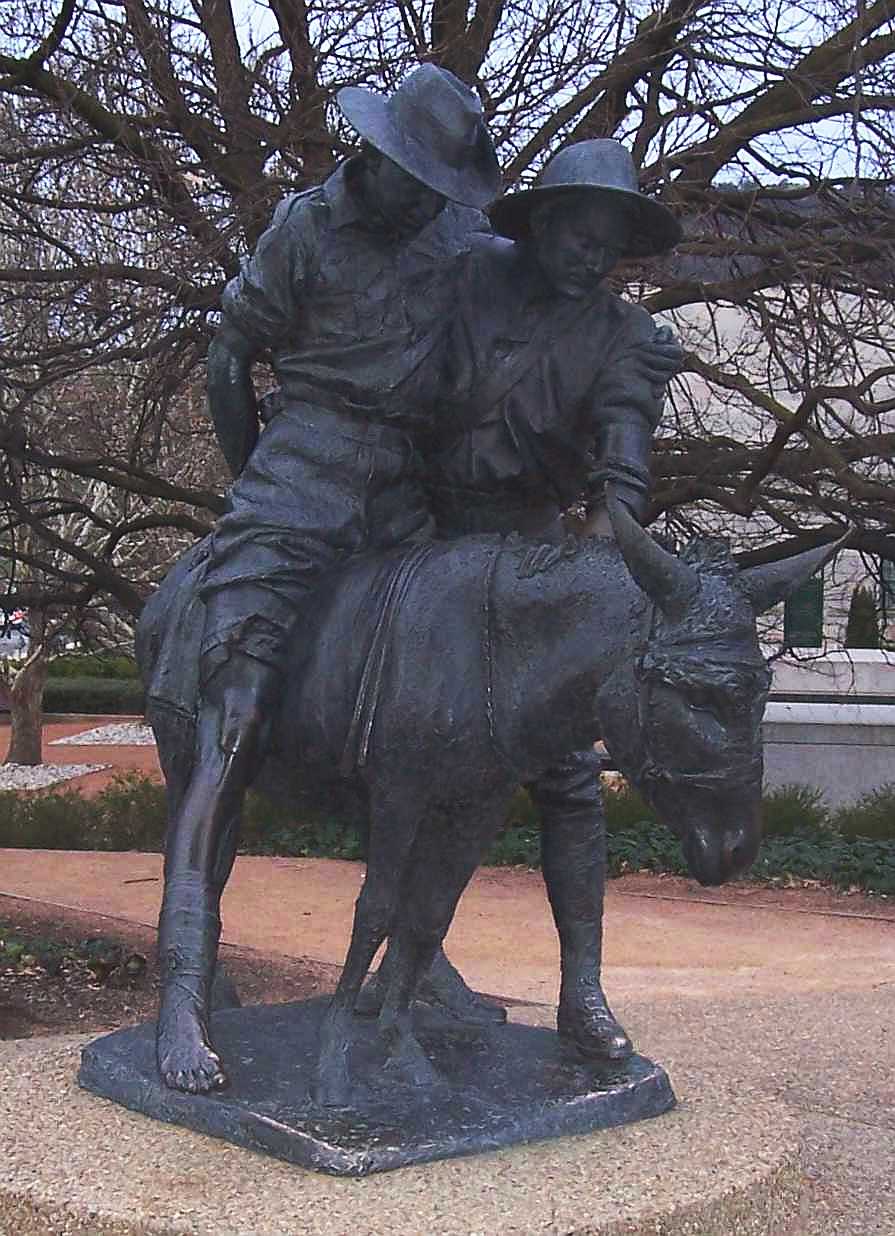
One of the many Australian memorials to the "Man with the donk".

Over the years there has been a fervent campaign to obtain a posthumous V.C. for Simpson. Many believe that the lack of a V.C. is a great wrong that should be redressed. In discussing this with my Australian husband, his views were clear; a V.C. would “mean the creation of an official myth. It should be left as it is, for those to whom it belongs.” And as a Geordie, knowing something of the background to Jack Simpson, the type of streets and houses he and his family would have lived in, even the donkeys on the beaches of Northumberland and Durham that were giving rides when I was a child, I agree with him.

Read more about Jack Simpson and his donkey on: http://www.anzacs.net/Simpson.htm; http://en.wikipedia.org/wiki/John_Simpson_Kirkpatrick;http://www.awm.gov.au/exhibitions/forging/australians/simpson.asp;http://www.convictcreations.com/history/simpson.htm; http:;//www.anzacday.org.au/spirit/hero/chp00.html; http://james-parsons.suite101.com/simpson-and-his-donkey-a91890; http://www.anzacday.org.au/spirit/hero/chp00.html; http://indymedia.org.au/2011/04/22/simpson-and-his-donkey-the-radical-truthhttp://adb.anu.edu.au/biography/kirkpatrick-john-simpson-6975; http://www.youtube.com/watch?v=398BlpdZnzo