Having a party in your pink whirlicote

Where would popular music be without cars? Whether it’s the explicitly erotic charge of Springsteen’s “Pink Cadillac” (especially as interpreted by Natalie Cole) or Golden Earring’s “Radar Love”, or the sun, surf ‘n sex appeal of the little deuce coupe and the fun, fun, fun of the T-Bird (till her daddy takes it away), cars are right there at the heart of it. Offering speed, comfort, the opportunity to get away, and of course, not forgetting the back seat, cars created opportunities for lovers that they just didn’t have at home, with the added frisson of taking a risk and perhaps being found out. And similarly,in their day, the vehicles that preceded automobiles – horse drawn coaches, carriages, gigs and broughams – offered exactly the same opportunities and had exactly the same mystique and reputation. And so did chariots. Chariots?

The earliest example that I’ve been able to trace of the theme is undoubtedly the ancient Egyptian example from a papyrus that is variously known as the Turin Erotic Papyrus or the Turin Satirical Papyrus. This fragmentary papyrus was probably created in the workmen’s town at Deir el Medina. Nothing is left to the imagination in this imagery. The scenes are explicit and graphic, and in one instance, a man and woman are having sex whilst the woman is in a chariot drawn by two other women and “driven” after a fashion, by a monkey standing on the yoke pole.

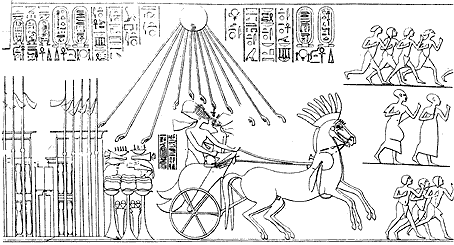
mahu-7Another less graphic ancient Egyptian example comes from the city of Akhetaten, built as a centre of worship to the Aten by King Akhenaten. One of the interesting aspects of Akhetaten is that it was built as a city with a road at its centre, and horse drawn chariots played a major part in daily life and ritual. In one very well known scene, Akhenaten and his great royal wife Nefertiti are shown embracing and kissing in a moving chariot under the protective rays of the Aten.

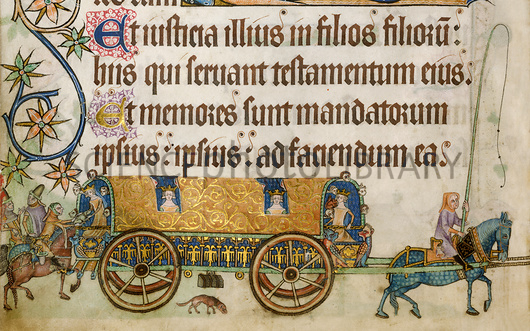
Royal women riding in a whirlicote - remind you of anything? One of them is being handed a little pet dog by a man on horseback.

Royal women riding in a whirlicote – remind you of anything? One of them is being handed a little pet dog by a man on horseback. Image from The Luttrell Psalter in the British Library.

Moving forward a few millennia, we find that apes or monkeys are still appearing as drivers of vehicles, in, for instance, the Luttrell Psalter; but of even greater interest from that document is one scene, showing a medieval conveyance for royal women. These vehicles are sometimes described as carriages, but in fact they are whirlicotes. These were long vehicles with fixed wheels that were only able to change direction by dragging the vehicle out of its position and into a new course. They were usually drawn by horses working as a team, three of them or more, in a single line. Whenever I look at the Luttrell Psalter whirlicote, I’m irresistibly reminded of girls having a night out in a stretch limousine.

The medieval whirlicote, whilst looking like the latest innovation in travelling in style and comfort, actually didn’t provide much of either of those qualities. This wasn’t entirely due to the springless and relatively unsophisticated vehicle itself, but also to the condition of the roads generally. Most men (and the majority of women too) preferred to travel on horseback until the middle of the 16th century, when innovations in horse drawn vehicles really began. The earliest true coaches were developed in Hungary, but it wasn’t long before they began to be used elsewhere in Europe. They were imported into England, and the first home-built coach was produced for the Duke of Rutland in 1555.

By the early 17th century, coaches and carriages were beginning to be widely used in and around London and they were no longer the prerogative of aristocracy or royalty. Their reputation as mobile love or lust nests was firmly established by the time Ben Jonson wrote his famous play, “Bartholmew Fair.”

Horse copers and fanciers, dealers, charlatans and all manner of rogues convene at the fair to drink, flirt, eat pig meat and buy presents. One group of rogues is determined to seduce the hitherto virtuous Win, a married woman of London. One of them, Knockem, describes her just as he would a horse.

“Is’t not pity my delicate dark chestnut here – with the fine lean head, large forehead, round eyes, even mouth, sharp ears, long neck, thin crest, close withers, plain back, deep sides, short fillets, and full flanks; with a round belly, a plump buttock, large thighs, knit knees, straight legs, short pasterns, smooth hoofs and short heels, should lead a dull, honest woman’s life, that might live the life of a lady?”

The rogues tell her she will be a free woman and a lady and have “green gowns and velvet petticoats”, elaborate hairdos and head-dresses, and one tells her that she will “ride to Ware and Romford i’ dy coash, shee de players, be in love vit ’em; sup vit gallantsh, be drunk and cost de noting…and lie by twenty on ’em if dou pleash, shweetheart.”

“Lord,” thinks Win, musing on the idea of roistering around in a coach after the confined life she has led with her husband, “What a fool have I been!”

Coaches play a major part in Kathleen Winsor’s famous novel set in Restoration London, “Forever Amber.” By this point the coach was a necessary item for the elite, and London traffic was already beginning to snarl up thanks to the sheer numbers of them. In one scene, Amber, who is working with a gang of robbers, goes to an inn to find a suitable dupe – a coney – that she can lure to be robbed. She sits discreetly at a table, pretending to be a fine lady waiting for her lover (who does not, of course, arrive), while she seeks out a suitably drunk and wealthy young man. Eventually one is drawn to here – and she suggests they leave together. He asks her how she got there.

“‘Why, I came in a hackney, sir,’ she replied, implying that no lady going to an assignation would be so foolish as to ride in her own coach which might be seen and reported.

“‘I protest, madame. So fine a person as yourself travelling about after nightfall in a hell-cart? Tush!’ He waggled an admonitory finger at her. ‘I have my coach just around the corner. Pray let me carry you to your home.’

Once in the coach, Amber pretends they already know each other. It doesn’t take much to convince him that he’s seen her in the King’s box at the theatre and that he’s already in love with her. He immediately attempts to seduce her.

“As his impetuosity mounted, Amber grew more coy, moving as far away as she could get, and giving a low giggle in the darkness so that he made a grab for her. They started to tussle, she yielding a little and then pushing him off as he tried to draw her against him, giving a cry of dismay as his hand went into her bodice and caught one breast.”

Amber gives him a slap which puts him off for a time, but it’s not long before he makes another attempt. Then they arrive at the place she pretends is her home, where the robbers are waiting for them.

“‘Sit up sir, for God’s sake.” She was straightening her clothes, pulling up her bodice, smoothing her hair…”

It’s not long before her victim is knocked on the head and all his valuables taken.

From the same historical period, but a factual account in this case, comes an account of purchasing a coach in the diary of Samuel Pepys. This is an important purchase and investment for the Pepyses, and receives quite a lot of attention in his diary. He’s almost decided on one at the coachmaker’s, when his mind is changed by the opinion of Mr Povey,which he values. “This done, he and I to talk of my coach, and I got him to go see it, where he finds most infinite fault with it, both as to being out of fashion and heavy, with so good reason that I am mightily glad of his having corrected me in it; and so I do resolve to have one of his build, and with his advice, both in coach and horses, he being the fittest man in the world for it, and do he carried me home, and said the same to my wife.”

He decides on one similar to Povey’s: “Thence with Mr. Povey spent all the afternoon going up and down among the coachmakers in Cow Lane, and did see several, and at last did pitch upon a little chariott, whose body was framed, but not covered, at the widow’s that made Mr. Lowther’s fine coach; and we are mightily pleased with it, it being light, and will be very genteel and sober; to be covered with leather, and yet will hold four. In typical Pepys’ fashion, he describes the first outing of the coach in sexual terms (“my wife, after dinner, went the first time abroad to take the maidenhead of her coach”) but is pretty soon disappointed by the breakages and expense. Prior to taking on this investment himself, he’s always ridden in other people’s or hired coaches. It’s costly to present an impression of status and wealth to the world, and maintaining a coach and horses is a good way to spend money rapidly. A stable is required, of course; somewhere to keep it; the right kind of horses and clothes for the coachman. It’s a great day when he buys his coach horses: “This day was brought home my pair of black coach-horses, the first I ever was master of. They cost me L50, and are a fine pair.” A little later, though, the cost of breaking a window and an accident when one of the horses gets a leg caught over the pole of the carriage, causes him concern.

If love, or lust, and marriage go together like a horse and carriage, then there’s one particular place and time that was most true – and I’ll be exploring that in my next blog.

Horses, history and humour in the “Mistress Meg and the Elizabethan Rogues” series

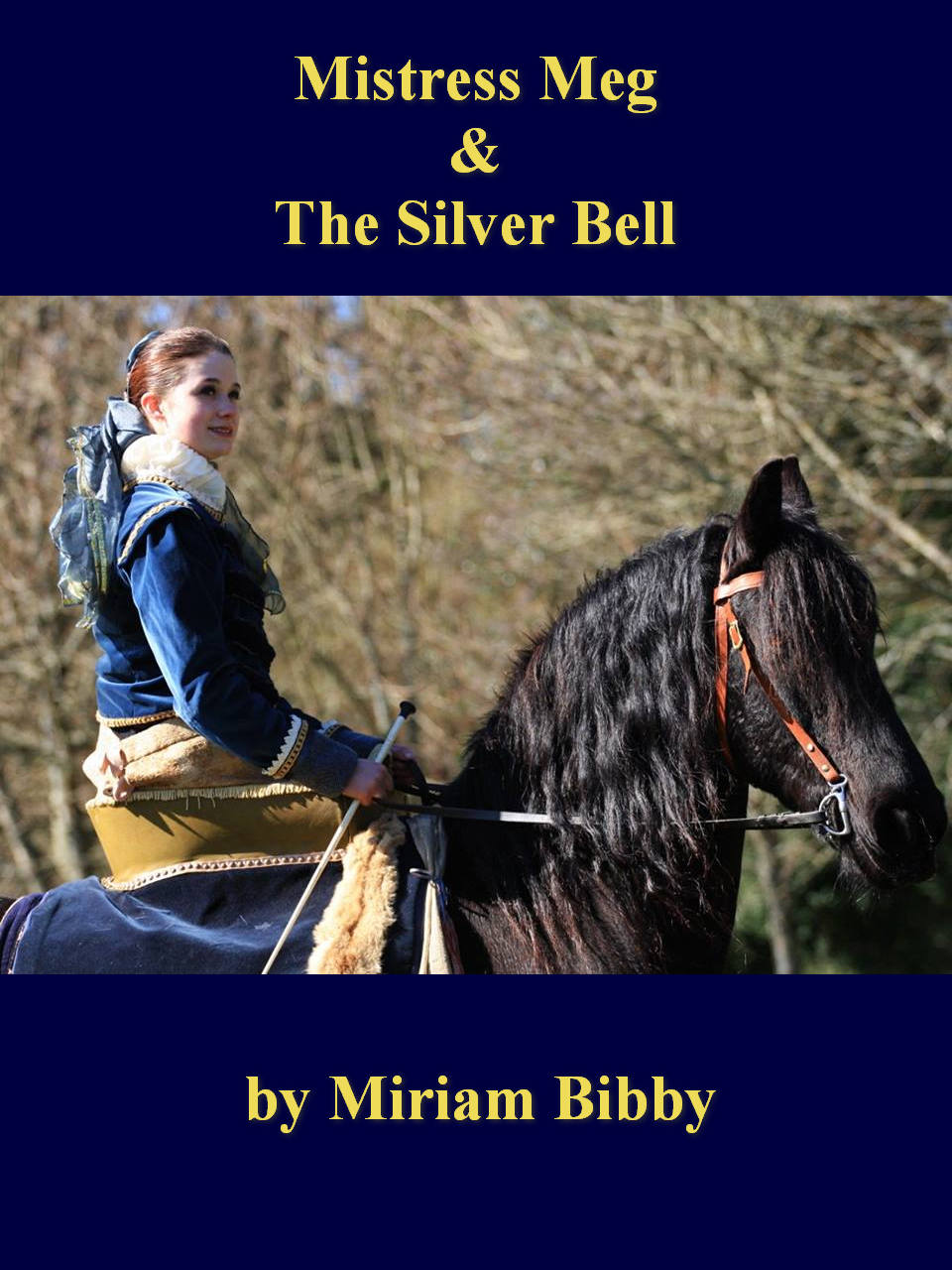
Mistress Meg and the Silver Bell cover

If you like horses and history, with a dash of humour and adventure, you’ll like the two novels that I’ve published so far in my series “Mistress Meg and the Elizabethan Rogues.”

The first book in the series is “Mistress Meg and the Prigger of Prancers”, in which we first meet cunning-woman Mistress Meg and her unusual servants Cornelius and Matthew, along with a “prigger of prancers” – a notorious horse thief – and many other characters. This is from the description of the book: “There’s mischief brewing in the town of Guildern. Mistress Meg and her servants are staying at the Goat in Chains Inn and her skills are already having an effect on the trade of the local cunning man. When a parcel of rogues arrives in Guildern, there’s sure to be trouble; and a valuable horse is at the centre of it.” It was first published in 2012. It’s available internationally for Amazon Kindle and there’s currently a promotion on this book on Amazon.com:

The next book in the series is “Mistress Meg and the Silver Bell” and it too is available as a Kindle download across all Amazon online stores: “As Mistress Meg and her loyal servants Matthew and Cornelius make their way to the town of Marcaster, the rogues are not too far behind them. If there’s opportunity for some underhand dealing involving a horse, the Jingler will be sure to discover it, and in the meantime he plans his revenge on Meg.”

History on Horseback – still history-ing, still horse-ing!

I’m just cantering through with a quick update. It’s been a long time since my last post but I’ve been busy – there’s a lot of activity on the History on Horseback Facebook page – why not join us there? I’ve also been making some History on Horseback products which you can find on Zazzle. I’ll be back again soon with more information, new posts and interviews – so watch this space! – Miriam

All the King’s horses

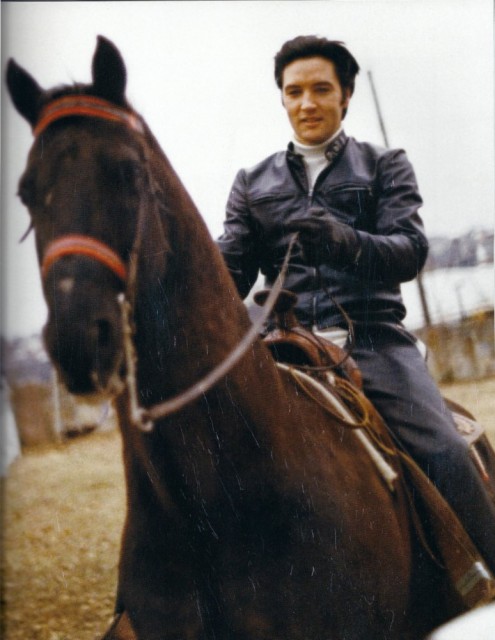
scan0018_638203The horse has always been associated with royalty, and rock royalty is no exception to the rule. In the history of rock and roll, there are many royals, but only one King: Elvis Aaron Presley.  One of the few remaining aspects of a life that is so otherwise so well known is his love of horses and riding. Lesley Pilling believes that Elvis spent his happiest times away from the celebrity circus, with his horses on his ranch, the Circle G. Lesley is now  on a quest to bring the place where he was most at home back to life, with the intention of making it a welcoming communal venue for visitors, locals and the disadvantaged. Lesley talked to Miriam Bibby about Elvis, the man, his horses, and her vision for the future of the Circle G Ranch.

Miriam Bibby:  Lesley, welcome to History on Horseback. Please tell us something about the Circle G and what it meant to Elvis.

Lesley Pilling: Thank you Miriam, it’s a pleasure to speak to you about Elvis, his love of horses and the Circle G Ranch. The Circle G Ranch is located about 15 miles south of Graceland (Elvis’ home in Memphis TN) in a place called Horn Lake just over the border in Mississippi. Elvis bought the ranch in February 1967. He first saw the ranch (then named Twinkeltown Farm) whilst out on a horse buying expedition. Driving by the ranch Elvis was attracted by the 75 white cross which was illuminated at night. As Elvis was quite a spiritual person and he was also looking for a place to house his ever increasing stable of horses, seeing the ranch for sale – Elvis being Elvis, bought the 163 acre property there and then – complete with its own herd of Santa Gertrudis cattle.

The Circle G Ranch was, Lesley believes, the place where Elvis spent his happiest times.  Priscilla Presley wrote in her autobiography of this time: "What seemed like a new life had begun.  We spent our honeymoon at the Circle G.  I look back at those weeks as a remarkable lull in the middle of a storm.  Elvis was between pictures.  I’ve never seen him so ‘free’, free of the entourage, the press, the Colonel and the incessant demands of his career.  It was just the two of us in our ranch house.  I loved cooking his breakfast....  After breakfast we’d saddle up our horses and ride them through the hills."

The Circle G Ranch was, Lesley believes, the place where Elvis spent his happiest times. Priscilla Presley wrote in her autobiography of this time: “What seemed like a new life had begun. We spent our honeymoon at the Circle G. I look back at those weeks as a remarkable lull in the middle of a storm. Elvis was between pictures. I’ve never seen him so ‘free’, free of the entourage, the press, the Colonel and the incessant demands of his career. It was just the two of us in our ranch house. I loved cooking his breakfast…. After breakfast we’d saddle up our horses and ride them through the hills.”

Elvis wanted to register the ranch as The Circle G, but as this name was already taken he registered it as The Flying Circle G – although to Elvis and his friends, family and fans it has always been known as The Circle G Ranch. Elvis’ ownership of the ranch took place at a time of great change in his life. In May 1967, after owning the ranch for around 4 months, Elvis married Priscilla in Las Vegas – they then returned to Memphis and moved onto the Circle G for the main part of their honeymoon. Priscilla is quoted as saying this was probably the happiest time of their married life. She got a chance to cook and clean and just take care of Elvis; they could actually be just a normal couple and she felt that Elvis was able, for the first time, to find peace at the ranch. Shortly after this Elvis would have found out that he was to become a father – another milestone in his life. His movie contracts were also coming to an end and we understand that the peace and freedom that the ranch afforded him enabled him to think very seriously about the direction his career might take in the coming years.

The ranch was a place where Elvis could escape the pressures of being ‘Elvis Presley’ and simply be a normal guy, hanging out with his friends and family and riding his horses.

MB: From your description, the Circle G and his horses were at the heart of Elvis’s life. The Circle G was clearly a place where he felt truly at home. Do we know when Elvis first rode a horse? What do we know about his relationship with them?

LP: Elvis loved horses. Although we’re not exactly sure if he had any experience of horses during his childhood years in Tupelo or Memphis, we do know that he rode horses as early as 1956 and at that time also spoke of his desire to own his own ranch. The collection of horses at Graceland began Christmas 1966 when Elvis bought a quarter horse named Domino for Priscilla as her Christmas gift. His enthusiasm for horses grew rapidly as he bought horses for his friends and family and soon the stable at Graceland was bursting at the seams.

We do know that Elvis loved to care for his horses and there are documented tales of the time and love he took in doing so. It wasn’t at all unusual for him to walk his horse Rising Sun for an hour after riding him for just 15 minutes just to make sure that the horse wasn’t harmed in any way. Elvis loved to work on his own tack – those times alone with his horses allowed him the peace and serenity that his hectic life style didn’t usually permit.

MB: How many horses did he keep on the ranch; and did he have favourites?

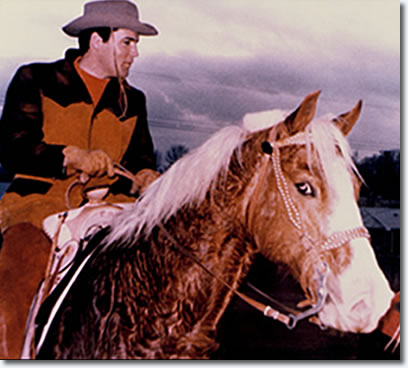
LP: We believe that Elvis kept over 24 horses on the Circle G – although we’re still researching. We recently spoke to a gentleman who sold Elvis horses and equipment and we’re constantly reaching out to acquire more information for our Circle G Memory Bank. His favourite had to be his American Quarter Horse, a Golden Palomino named Rising Sun. Most of the photographs you see of Elvis on horseback show him on Rising Sun. He loved that horse and Rising Sun loved Elvis. He did own another memorable horse, Bear – a beautiful black Tennessee walking horse.

Elvis Presley's favourite horse was the palomino Rising Sun. Priscilla Presley wrote: "I remember one day I happened to look out of the window.  It was twilight.  The sky was aglow in misty blue and radiant pink.  There was Elvis walking Rising Sun, his Golden Palomino.  I saw them as silhouettes against the darkening sky.  Elvis was walking slowly, I could practically hear him breathe.  His breath was easy, his body relaxed.  At that moment I was convinced that my husband had actually found peace.”

Elvis Presley’s favourite horse was the palomino Rising Sun. Priscilla Presley wrote: “I remember one day I happened to look out of the window. It was twilight. The sky was aglow in misty blue and radiant pink. There was Elvis walking Rising Sun, his Golden Palomino. I saw them as silhouettes against the darkening sky. Elvis was walking slowly, I could practically hear him breathe. His breath was easy, his body relaxed.
At that moment I was convinced that my husband had actually found peace.”

MB: What role did horses play in Elvis Presley’s professional life, in music and movies?

LP: Some of Elvis’ best known films featured horses – Love Me Tender, Flaming Star, Stay Away Joe and Charro. There was one hairy moment during the filming of Flaming Star when a horse ran away with Elvis – this understandably shook him up for a while but he quickly overcame his fear and was over it long before he bought the Circle G.

MB: It’s astonishing now to think of the many achievements of his all too brief life. What happened to the ranch after his death?

LP: Yes, Elvis achieved so much in a relatively short period of time. The world is aware of much of that but there is so much more to the man than is generally talked about.

Elvis was a very spiritual individual who was constantly searching and learning. He had a deep faith and the Circle G resonated with him for that reason. Even today when you stand and look at that 75 foot white cross that first drew Elvis there you can feel that calm and peace that Elvis did.

Elvis also did a great deal for charity, much of it anonymously. Here at the Circle G Foundation our aim is to continue his charitable and humanitarian legacy at the ranch. At the time of his passing Elvis didn’t own the ranch. Although we do have documented statements that he continued to visit the property throughout his life and spoke to friends and family about it fondly. The ranch has been in private hands for many years. We believe this is our chance to return Elvis’ spirit there and in doing so continue his legacy of helping those less fortunate.

MB: When you became involved with the Circle G, the germ of an idea began. How did your involvement come about?

LP: I have been an Elvis fan since 1968 (aged 7) so obviously I’ve known about the ranch. I didn’t get to visit Memphis until 2008 and then it wasn’t until 2010 when I got the chance to visit the Circle G. Finding it in the terrible state it’s in reduced me to tears and I promised myself (and Elvis) there and then to do whatever I could to save it. On returning home I launched the campaign on Facebook. Now three years later the Circle G Foundation has supporters all around the world. We have a Management Team and 29 Ambassadors working hard to spread the word – and our support grows daily.

MB: Since you first saw the potential in the Circle G, the possibilities have expanded immensely so that it’s now a very rich vision indeed. Tell us something about your plans for the future, and where you are currently.

LP: Yes, since we began in 2010 our vision for the ranch has clarified and expanded. As I mentioned previously we feel this is the ideal location to continue Elvis’ charitable and humanitarian legacy. We would like to establish facilities for the disabled (hopefully riding for the disabled), help the disadvantaged by running programmes on the property and also establish rest and recouperation for service veterans. Of course it will be a wonderful site for Elvis fans to visit and stay but we also want to attract families to what will be a unique visitor experience. We are currently reaching out to potential investors who can help us achieve our dream. Although we realise that there is no quick fix and that such plans take time to come to fruition – we have achieved an awful lot in the past three years. Our profile both inside and outside the Elvis world continues to grow – and we hope that through interviews such as this we can reach out to the equine community, we’d love them to be involved.

MB: Are you finding the support to bring this vision to reality, both locally and internationally?

LP: One of the very special things about Elvis Presley is that he continues to be a global phenomenon. There isn’t a country in the world that doesn’t recognise his name and there isn’t a country in the world where you can’t find an Elvis Presley Fan Club! Here at the Circle G Foundation we work very hard on this ‘international’ fan base. We have our own Ambassadors in Australia, South Africa, Italy, France, UK, Canada, Belgium, Netherlands, USA, Denmark – so we have the world pretty well covered and we’ve had messages of support from every continent – so yes, we are finding that international support. That doesn’t mean we will stop reaching out – supporters are always extremely welcome and we love them to get in touch, no matter what field they come from or what nationality they are. If anyone does want to get in touch with us they can visit our website  where they’ll find lots more detailed information, pictures and interesting items to look at. Use our Contact page to send us a message – we’d love to hear from your readers.

MB: How do you think Elvis would feel about the project? What would he say?

LP: This is a question we’ve asked ourselves many times. We hope that he’d be proud of his fans as we work towards continuing his charitable legacy on the ranch. We know he loved the Circle G and we want to return his spirit there. It’s a wonderful thought to imagine him smiling that million dollar smile and saying – ‘I have the best fans in the world!

MB Lesley, thank you – good luck with your project! If any followers of History on Horseback would like to know more, or get involved, check out the project web site at http://www.circlegfoundation.co.uk and the Circle G Facebook page.

Not just for girls: the past – and future – of the pony book

Aside

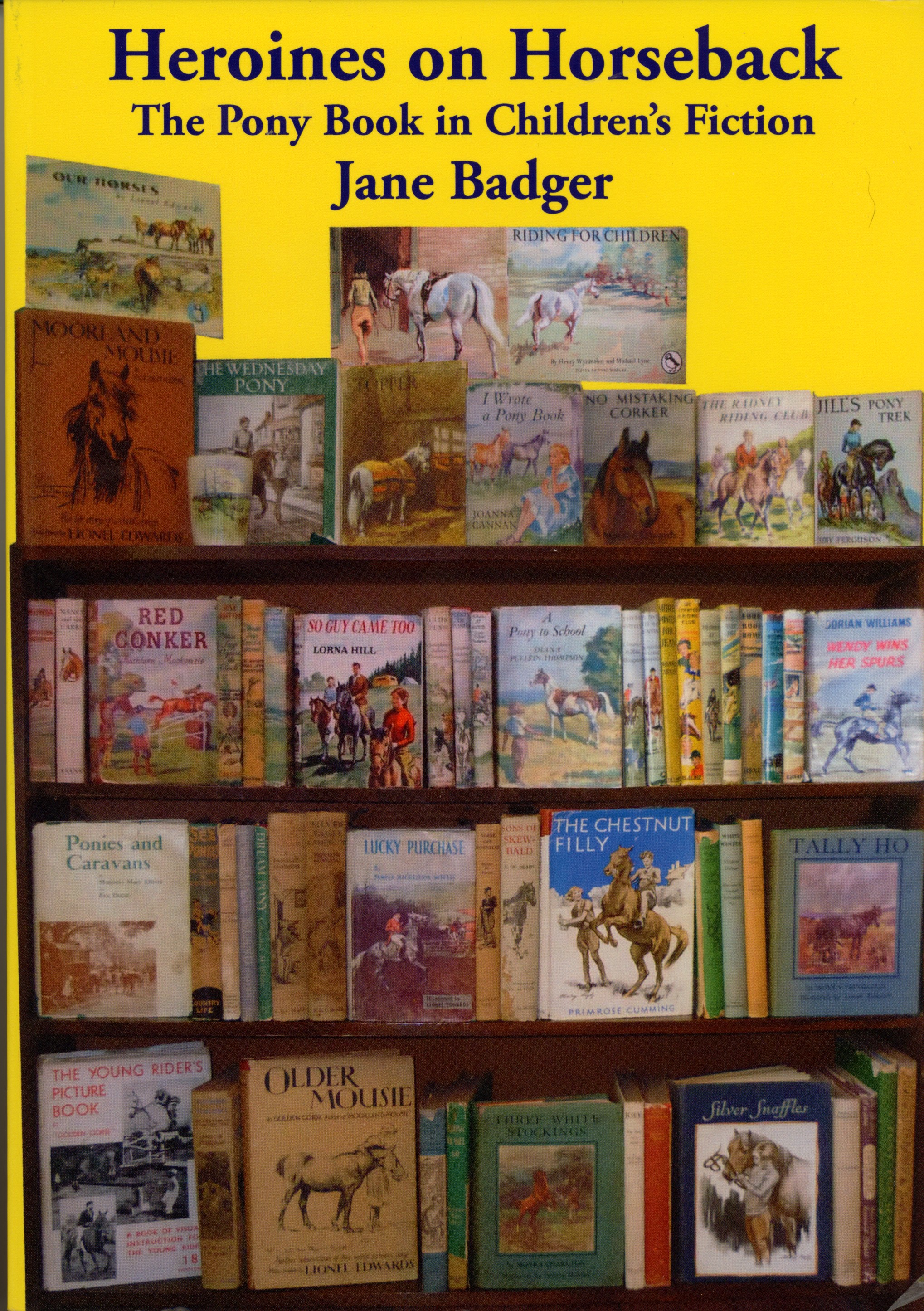
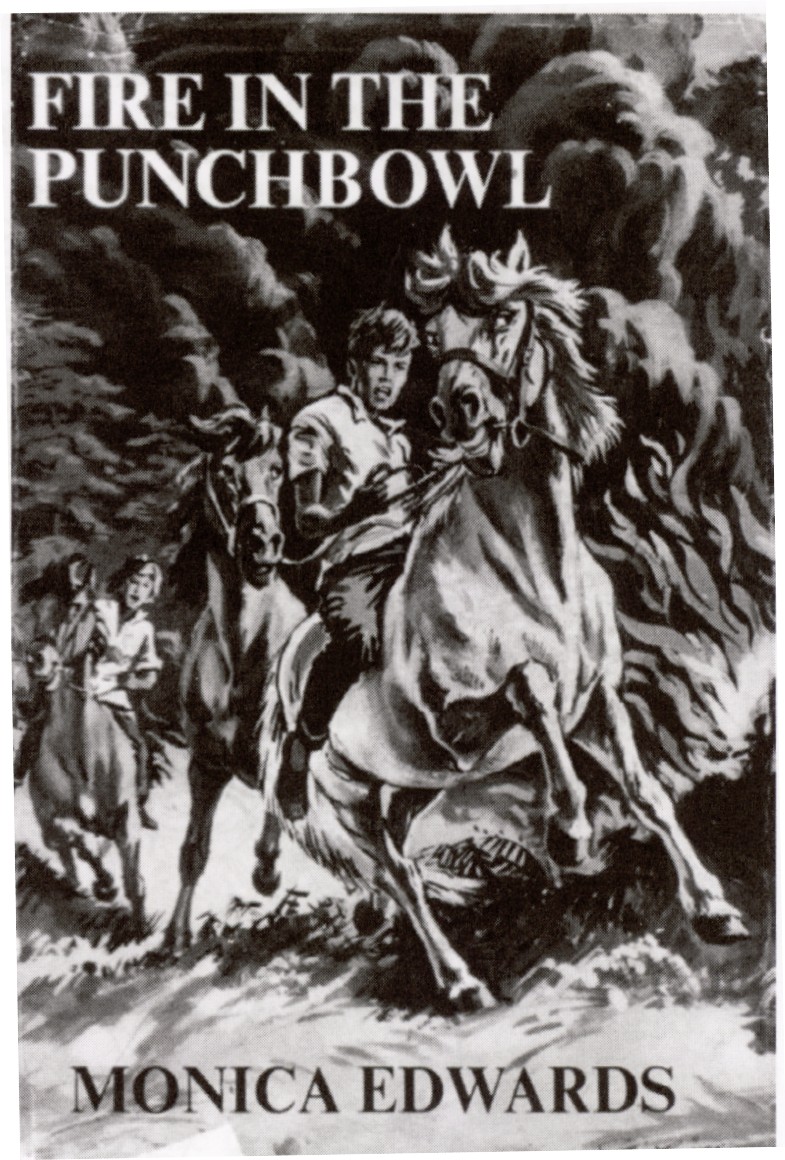
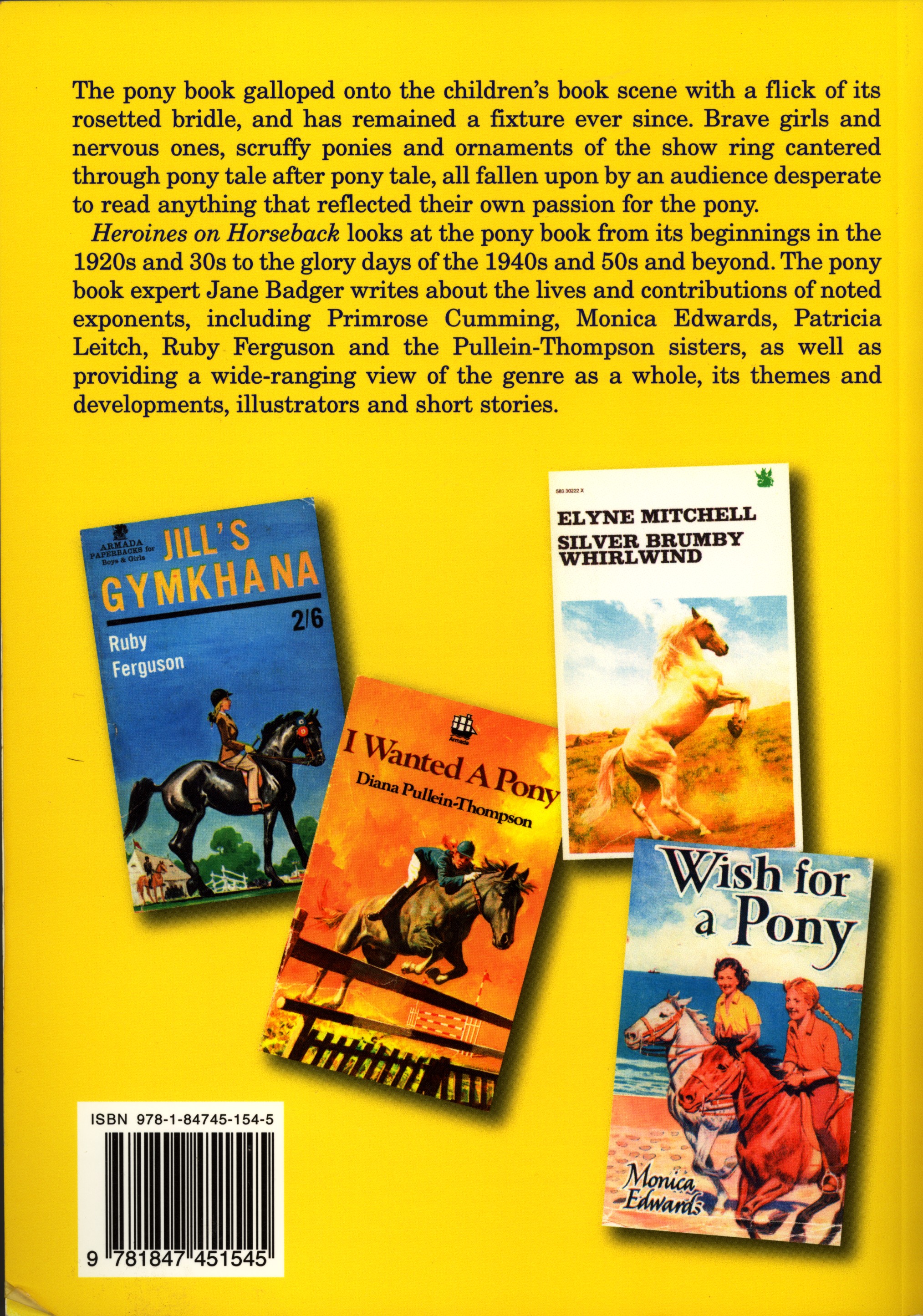
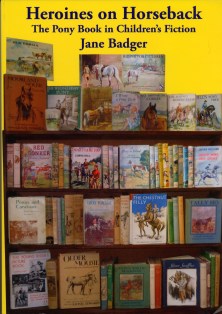
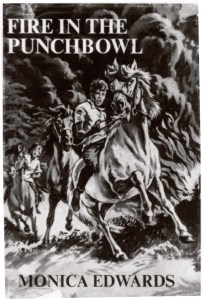
ImageThe pony book, its cover frequently evoking sunny gymkhana summers, rosettes and pony-mad girls, is a standard of children’s fiction. However, there’s more to it than that.  When Jane Badger, already an experienced writer, blogger and researcher of the genre, set out to write Heroines on Horseback – The Pony Book in Children’s Fiction, she had little idea of just “how many more titles I would uncover.”  The books are not only about wish-fulfilment and ambition, but also about dedication, loss and the cost, in every sense of the word, of turning a dream into reality. I talked to Jane about her work and the history and influence of the pony book.

Miriam Bibby: First of all, welcome to History on Horseback, Jane.  The pony book has been a popular genre for young people (and girls in particular) for decades.  It’s likely to have played some part in the formative reading of anyone with an interest in the history of the horse and I’m sure that many of us recall the experience of our first pony book. Tell me about yours. How did you respond to it at the time?

Jane Badger: Thank you for having me on your blog!  I read anything and everything as a child, so in the scramble to cram in as much as possible, I’m not 100% sure what my first pony book was. I’m fairly certain it was Diana Pullein-Thompson’s Riding with the Lyntons, which is certainly the first pony book I owned. It was the Armada edition with the Mary Gernat illustration and the dung brown cover. In retrospect, it’s an odd book to be completely hooked by, as it launches fairly early on into the death of a pony in the road, and the ostracism of the heroine by her new found friends, but I didn’t care. I read it, and re-read it. My father died when I was small, and I can’t ever remember not knowing that, so death had always been part of my world and so didn’t disturb me. I knew it happened. What I do remember being absolutely enchanted by was this marvellous world where people actually had a pony of their own. I didn’t know anyone who had a pony of their own, so to step into the world of someone who did was heaven.

MB: Your book Heroines on Horseback – The Pony Book in Children’s Fiction traces the development of the pony book from 18th century animal story precursors, with the first “pony-narrated” text that you’ve found dating to 1800, long before Sewell’s Black Beauty (1877). Some recognisable pony book themes began to emerge in this early book, The Memoirs of Dick, the Little Poney (Supposed to be written by himself…)  Can you outline a few of these?

JB: Ah Dick. I can recommend reading Dick, who’s freely available on the internet. He has a voice all his own. Dick starts his story from foalhood, through his capture and breaking in, and then on through several different owners (some good, some not) until he ends up as a happy child’s pony. There’s a strong moral bent in a lot of animal literature: its aim is didactic. It wants to teach the reader how to treat the narrator animal well, and that certainly happens with Dick, who has some fairly grim experiences at the hands of a young and selfish master. Dick is of course saved by the good graces of humanity, as many pony-book ponies after him were. It’s something that’s remained true of most pony literature; the power of humanity over the horse’s fate. Interestingly in the 20th  century you do get the odd story where the horse breaks free and forges its own way (H M Peel’s Jago for one), but it’s rare. Dick’s experience,  where it’s humanity’s responsibility to care, is the norm.

MB: People with a little knowledge of the pony book might think that the books are about upper crust gels who go to boarding school and attend gymkhanas. In fact, as your book clearly shows, that’s simply the over-worked – hackneyed – end of the genre. Themes of class, money and status are, in fact, often developed in ways that people might not expect.
Archetypal

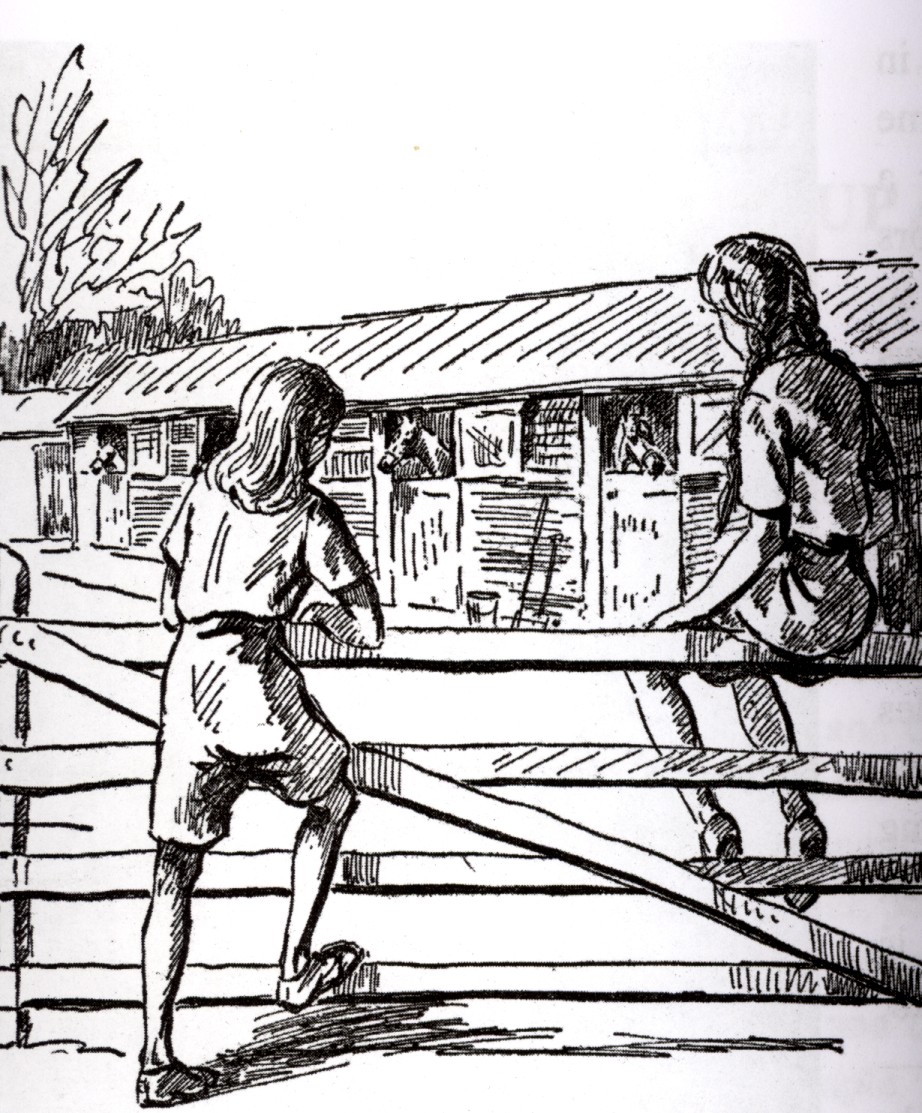
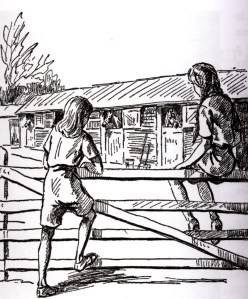
An archetypal image? Illustrator Geoffrey Whittam specialised in pony books. His work extends from the idyllic, such as this, to the dramatic and adventurous.

JB: Yes, that’s true. Diana Pullein-Thompson was particularly keen on showing characters who had money but were still human beings, who didn’t deserve the opprobrium thrown at them because they were wealthy. Her Christina, in Three Ponies and Shannan, has stacks of money; large, beautifully done house, three lovely ponies, a groom, and anything material she wants. It’s Christina though, who’s the heroine;  the poverty-struck child, Charlie, child of the vicarage is unkind, thoughtless and a bully. As well as subverting the accepted mores, you get authors who take a good look at what it’s actually like to have very little money and to try and get a pony. There’s Veronica Westlake’s Ten Pound Pony where the children have a real, hard, slog to get a pony, and probably best of all, K M Peyton’s Fly-by-Night. Her heroine Ruth lives in a family where there is no spare money whatsover, but Ruth buys a pony with her sparse savings and then tries to keep it in her back garden. It’s the best of the books which aims to show that the pony book dream may be achievable, but it won’t be without a cost.

MB: I must say the matter of “pony book poor”, discussed in your book, did make me laugh out loud. It seemed to be a case of: “Down to our last pony and we have to move to a draughty rectory with only three acres on the edge of town – poor us!” That’s definitely not the whole story though. Which writers do you think stand out in the development of the pony book in unique and challenging ways?

JB: K M Peyton and Patricia Leitch. Patricia Leitch is a much under rated author. Her The Magic Pony, reissued last year by Catnip can be read as a (very good) straightforward pony story and a study of what it’s like to die in today’s society. K M Peyton’s characters are always arrestingly real.

MB: I’ve always thought that two important – and undervalued – themes of pony books are egalitarianism and feminism, though that’s perhaps not a word the protagonists would use. They simply get on with what they want to do. However, in your book, Stacey Gregg, successful 21st century pony book author, describes Ruby Ferguson’s heroine Jill Crewe as “funny, feisty and unapologetically feminist.” We can learn a lot from our horseback heroines about independence, responsibility and resourcefulness, amongst other qualities. Are horseback heroines feminists? What else do the books (and the ponies in them) teach us?

JB: I suppose that depends on what your definition of feminism is: if your definition of it is that you get on and do what you want to do, and don’t let yourself be defined by stereotypical ideas, then yes, a lot of them are. I’ve already mentioned the strong thread of morality that’s present in most horse literature: indeed in most animal literature. Caring for the animal properly is paramount; unselfishness – putting the animal’s needs before your own – is key.

MB: Many avid followers of Ruby Ferguson’s “Jill” felt seriously let down by the disappointing end to the series, when, at the end of the book, Jill apparently gives up her dreams and ambitions to work with horses, and to write, in order to become a secretary. Despite the fact that she’s been successfully doing both as a younger teenager, neither is seen as appropriate for her as an adult. Even after fifty or sixty years, it’s clearly something that still rankles with many readers. Why do you think Ferguson took this final course for her upbeat and inspiring heroine?
caney

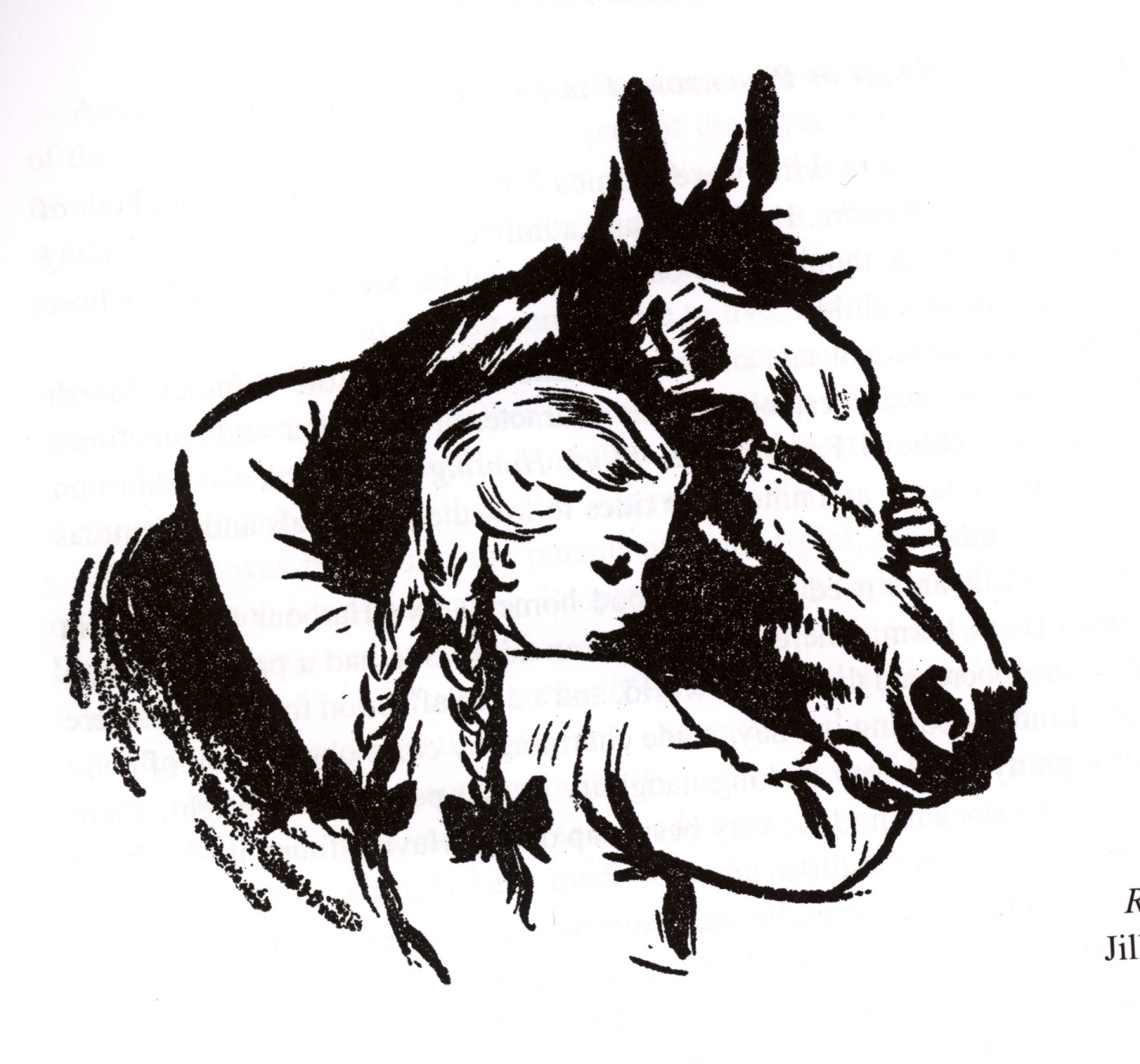
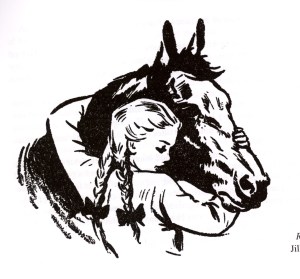
Jill, Ruby Ferguson’s heroine on horseback, was an inspiration to many; but ultimately the disappointing ending to an otherwise satisfying series is “a puzzle”, says Jane Badger. Illustration by Clifford Caney.

JB: Jill’s a puzzle, or at any rate the situation Jill ends the series in is a puzzle. All through the series, Jill is the girl most pony mad girls want to be. I think it’s because Jill is the quintessential wish-fulfilment figure that it’s such a shocking blow when she gives it all up to become a secretary. Yes, I know you can say that she’s an author, as she’s nominally writing the books, but that’s not the point of the scene in Pony Jobs for Jill when Captain CC tells Jill and Ann it’s time to stop mucking about with horses and buckle down to real life and train as secretaries. It’s the sensible career that’s the focus. No one says to Jill “Oh, and of course you can continue your writing and your job will help you survive.” It’s the conventional job that is the whole point of that last scene. Writing, and indeed working with horses are entirely left behind.

Whilst I can see something in the argument that this might have led some readers to question the beliefs that made Jill act the way she did, I think readers react to Jill too personally to start questioning her actions in that way. For them, she’s not a symbol of oppression, or otherwise: she’s a character for whom the reader cares. It’s astonishing to the reader when Jill happily agrees with the plan of doing a secretarial course. Secretary to the PM! says Jill, in a rather pathetic echo of her earlier career aspirations: a few books earlier she wanted to be an MP.

I think there’s an argument for saying that Pony Jobs for Jill is the rather uneasy intrusion of the authorial voice into a series which was classic wish fulfilment. It’s like Harry Potter giving up defeating Voldomort to be an accountant or going into management at Sainsbury’s. Harry doing a realistic job isn’t the point of the books for the reader, and the same is true for Jill.

MB: It’s interesting that the rise and rise of the pony book heroines paralleled the rise of the motor vehicle and the collapse of the working horse population in general. If Enid Bagnold’s 1935 National Velvet hadn’t “given voice [to].. the great galloping passion” of girls for horses, as you vividly describe it in your book, it might almost appear that girls were inheriting a box of outgrown toys from an older brother who has lost interest, particularly as heroines came to dominate the genre in the 40s and 50s.  However, the only writer to have explored in depth this theme of the rise of the machine versus the fall, or at least diminishing, of the horse – with spectacular success – is K.M. Peyton in her Flambards trilogy. Any thoughts on this?
whittam2

Riding horses is currently seen as a mostly female activity, but there have always been attempts to balance this. Illustration by Geoffrey Whittam.

JB: I’m not sure the horse has diminished: yes, it has as a working animal, but the popularity of riding as a leisure activity has grown and grown. The focus has changed to the horse as a companion in leisure, and pony books reflect that. Your question does raise the issue of the whole position of boys and riding: there are very few, and the number who are members of the Pony Club goes down year by year. Riding’s seen as a feminine activity, though interestingly that very thing is being addressed in Victoria Eveleigh’s latest series, Joe.

MB: Leading on from the last question, there’s a case to be made for the most balanced literature in this genre appealing to both boys and girls. You discuss this balance in Heroines on Horseback through various examples.  My favourite pony book (if that’s an accurate description of it), and one of the first that I read (All Change by Josephine Pullein-Thompson) is written in the first person from the perspective of Douglas, the eldest of five children, whose father’s future employment is uncertain.  I found the combination of well-developed and complex characters with two believable strands dealing with secrecy and deception, interspersed with gripping dramatic episodes, very compelling; and perhaps unusually, the protagonist is male.

JB: All Change is a fine book! Josephine Pullein-Thompson was very keen that boys should have an equal part with girls in her stories. K M Peyton also has characters both male and female: it’s interesting that her heroine Ruth goes on to marry bad boy Patrick and gives up horses, turning her passion and single mindedness on a human. It’s the boys, Jonathan and Peter, who keep up with horses. Is it the same in Europe, I wonder, the pony and the pony book being seen as a girl thing? In America, horse books appeal to a wider audience, possibly because of the USA’s Western and cowboy heritage, which forms the subject for a lot of its equine literature. But yes, to return to your question, the best books show a balance, or else take a good look at why the imbalance is so very marked now.

MB: As with all fiction, pony books deal with the big questions in life: death, loss, love, change, war; and, as also, as you comment, “quite rightly, the normal preoccupations of teenagers”, that’s to say who fancies whom. Riding with the Lyntons includes references to a false murder accusation and many of the books have neglected or challenging children in them – and often these are the children of wealthy parents. I was particularly surprised to read about Dorian Williams’ Wendy trilogy, which I haven’t read, which seems to deal with exploitation and hints at abuse; aspects that are certainly found within the equestrian competitive world but rarely openly discussed.

JB: Sexual abuse I think is only really hinted at in the Wendy books: Wendy’s a young girl working away from home for the first time, and my reading of the books is that Dorian Williams was keen to give starry eyed youngsters whose greatest dream was to work with horses at least some idea of what could go on. Having said that, the starry eyed can be enormously obtuse, and I’m not sure they’d have picked up on it. Glenda Spooner’s The Silk Purse looks at the shenanigans of the showing world head on, and there are American books which take a good look at the nastier side of the horse world too. You’re right that they’re rarely discussed: in a genre which is often straightforward wish fulfilment, the flip side of the dream doesn’t often get the room it ought to.

MB: Do pony books and their heroines influence, or rather reflect, successive generations?

JB: Good question. I think it’s a bit of both. One thing that did surprise me when I started researching horse literature was the very real effect Patricia Leitch’s Jinny books had had on people who read them as a teenager. They felt that for the first time, here was someone who felt and acted as they did. If you did a survey of people who have chestnut Arab mares, I’d bet a good proportion of them read Jinny when young.

MB: The pony book is still alive and well in the 21st century, although there’s some discussion – and even concern – about the “pinkification” of the genre. Can you describe this phenomenon and discuss its implications?

JB: Susanna Forrest is very good on this in her equine memoir, If Wishes Were Horses. Some of it is down to the objectification, or even the commercialisation of the horse. When you look through vintage equestrian magazines there are of course advertisements, and if you wanted to spend shedloads of money you’ve always been able to. What’s different now is the massive, massive range of stuff that horses are supposed to need: wardrobes of rugs, pots of supplements, a thousand different grooming tools… That commercialism reflects society as a whole of course. Besides that, there’s the active decision on the part of toy retailers and publishers to market books for girls in a very specific way: the cover must be pink, the characters on it cartoons, and if you can add some sparkles in, so much the better. Of course what’s inside may not be even remotely pink and fluffy, but it all goes to mark the book out as something not for boys. Besides marking out the horse world as something exclusively for women and girls, I wonder if it also changes the way the horse itself is viewed, so that it becomes an object on which time and money is spent, with perhaps its essential horse-ness being lost.

MB: The pony book authors of my youth that I best remember – to misquote Black Beauty – are the Pullein-Thompsons, K.M. Peyton, Gillian Baxter and the two Monicas (Dickens and Edwards). The Jill books were just slightly too early for me, the Jinny books somewhat too late. However, reading the books of my own generation set me on a search for earlier ones and so I did also discover Ruby Ferguson, Mary Gervaise, “Golden Gorse”, Joanna Cannon and Primrose Cumming, amongst others. And, of course, Bagnold’s magnificent National Velvet must be a book that still has power today. Is there any sign that the current generation of “pink and sparkly” pony book readers are discovering the writers of the past? Or has the world simply changed too much for those early writers to have any relevance for 21st century readers?

JB: Well, Jill’s being republished and is selling well. K M Peyton’s backlist has been bought up by Random  House, who must feel there’s some mileage in it, and of course Jinny’s being republished too. As for the earliest authors, if you have an imagination you can make that leap, and I think most people are able to do it – children in particular, as they’re not necessarily as hide bound as adults can be.  There’s also the element of being able to see that years ago, other people loved the horse just as much as you do, with all the issues of continuity and difference that that throws up.

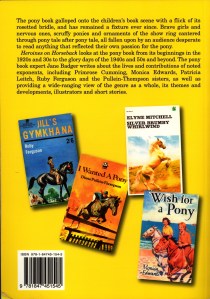
MB: And hoping for a strong future for the pony book provides a good point to conclude! It’s been great fun finding out more about the history of the genre. Jane’s book is published by Girls Gone By (GGB) Publishers and lively discussions on the topic of pony books and their authors can be found at Jane Badger Books http://www.janebadgerbooks.co.uk/   Backcover
The Ancient and Royal Order of Poop and Scoop

For research purposes, I’ve recently found myself reading a number of non-fiction books about the relationship between Elizabeth I and Robert Dudley, Earl of Leicester, her “Sweet Robin”, with whom she carried on a long and flirtatious relationship. They had known each other most of their lives and had both been incarcerated in the Tower of London at the same time whilst young. They each had a parent who had died as a traitor under the blow of the headsman’s axe. Their support for each other through the stress and trauma of their early lives undoubtedly contributed to the length, and indeed success, of their unconventional friendship, or love affair – however you want to view it.

Dudley was Elizabeth’s Master of the Horse; and the interesting thing about that is how few historians comment on the significance of it. Biographers are happy to discuss whether the relationship between the two of them was sexual; whether or not they were complicit in the death of Dudley’s wife; whether or not a certain portrait depicts Elizabeth and Leicester apparently doing the “Volta”, which looks like an early version of the jive. Whoever they are, the man has his hand on an intimate part of the woman’s anatomy as he throws her into the air and the woman doesn’t look in the least offended. Far from it.

Being Master of the Horse to a monarch means taking on a historically powerful role along with the title. When the ancient kings of Egypt, their courtiers and military leaders adopted the use of the horse and chariot, there was not only a requirement for a “Master of the Horse”, but also a pre-eminence and importance conveyed by the title to its holders. One of the best known of these was Ay, Master of the Horse at the court of King Akhenaten. Sadly, no manual of responsibilities or training, horse care and management has yet been found in ancient Egypt, although we can reconstruct a certain amount of knowledge from one or two remaining stable block foundations and other archaeological remains, from chariotry and equipment, mainly from Tutankhamun’s tomb, and from some royal inscriptions, particularly those of Amenhotep II and Ramesses II.

What we don’t know is how much of the ancient role required a hands on approach. It seems unlikely to have simply been a status title. Some knowledge of horse care and management would be required, but possibly that wasn’t the key skill in acquiring the title. The author of the most ancient treatise on horse training, the Mitannian Kikkuli, was neither royal nor a courtier. He was a practical trainer recruited to impart his knowledge to what author and hippologist Anthony Dent calls, with his usual forthrightness, “the thickear squadron-leaders of the Hittite Chariotry Corps.” From the beginning of the relationship between horses and humans, horses have conveyed status to those who could understand their natures and make use of them for display, in warfare and in hunting. Mostly, though, the trainers and grooms could probably only bask in reflective glory as they watched the cream of their various national elites claim the horsemanship credits. King Amenhotep II of Egypt claimed that he was given the best horses from his father’s stable and that he understood their nature and behaviour better than anyone else; Ramesses II said that after the Battle of Kadesh he would visit his stables every day to feed his horses, Victory-in-Thebes and Mut-is-Content, with his own hands, so valiantly had they performed on the battlefield. Thanks to him – and the unseen, unacknowledged army of trainers, handlers, veterinary specialists, water and fodder carrying grooms and underlings, of course. Many of the grooms appear to have been Nubians and it’s highly likely that Nubia had its own extremely knowledgeable horse culture before that of Egypt. They were specialists, specially recruited for the job; but most of the status-bearing roles went to Egyptians.

And so, through the ages, from the wily old courtier Ay, through the dashing Duke of Buckingham in the reign of James VI/I, right up to modern times, rulers and their Masters of the Horse go together like a – well, like a horse and chariot. Or two horses and a chariot. So, what do you think Elizabeth and Robert talked about when they got together? Did they share sweet flirtatious nothings or discuss the Spanish situation or laugh over a scandalous poem about the court? Of course they didn’t! They talked about HORSES, for goodness’ sake. And where there are horses, one thing predominates, the most significant and difficult part of horse-keeping. A stable of 200 horses produces a LOT of muck. It is either a useful by-product or a damn problem. If you can’t manage muck, you can’t manage a stable. A modern day riding stable near the Giza pyramids took its muck out to the desert for years, resulting in interesting stratigraphy that archaeologists have come to call the “HSS layer”. One of the “s’s” stands for “sand”. You can guess the rest. Meanwhile, back in Elizabethan England…

“Robin!”

“Yes, my liege, my most adorable Gloriana, what is it?”

“Grey Tilbury refused his breakfast this morning! Even though I offered it to him with my own fair hands! Robin, what is amiss with him? Is it colic, think ye?”

“Nay, most supreme monarch, it is simply the fresh spring grass. That is the only thing that tempteth him…”

“Oh. Have a care, Robin, that he overindulgeth not. For the pony gout is a terrible scourge. Why, only yesterday I was reading in the “Proclamation of Ye Oddfellows of Ye Noble Horse” that – ”

“Fear not, Ma’am, for I will restrict him to but a few hours in the forenoon.”

“Two hours, Robin! But two hours, for according to the Proclamation…”

“Aye, Ma’am. As Your Majesty wills. And, if you would care to cast the Royal gaze upon this?”

“What is it?”

“It is the proposed arms for the collectors of dung from ye royal paddocks. A crossed shovel and broom argent, over bucket or, from which steam is rising, with the motto “ordure et endure” on field vert…”

Queen (clapping hands with joy): “Just the job, Robin! Just the job.”

From Skyros to Scottish skies

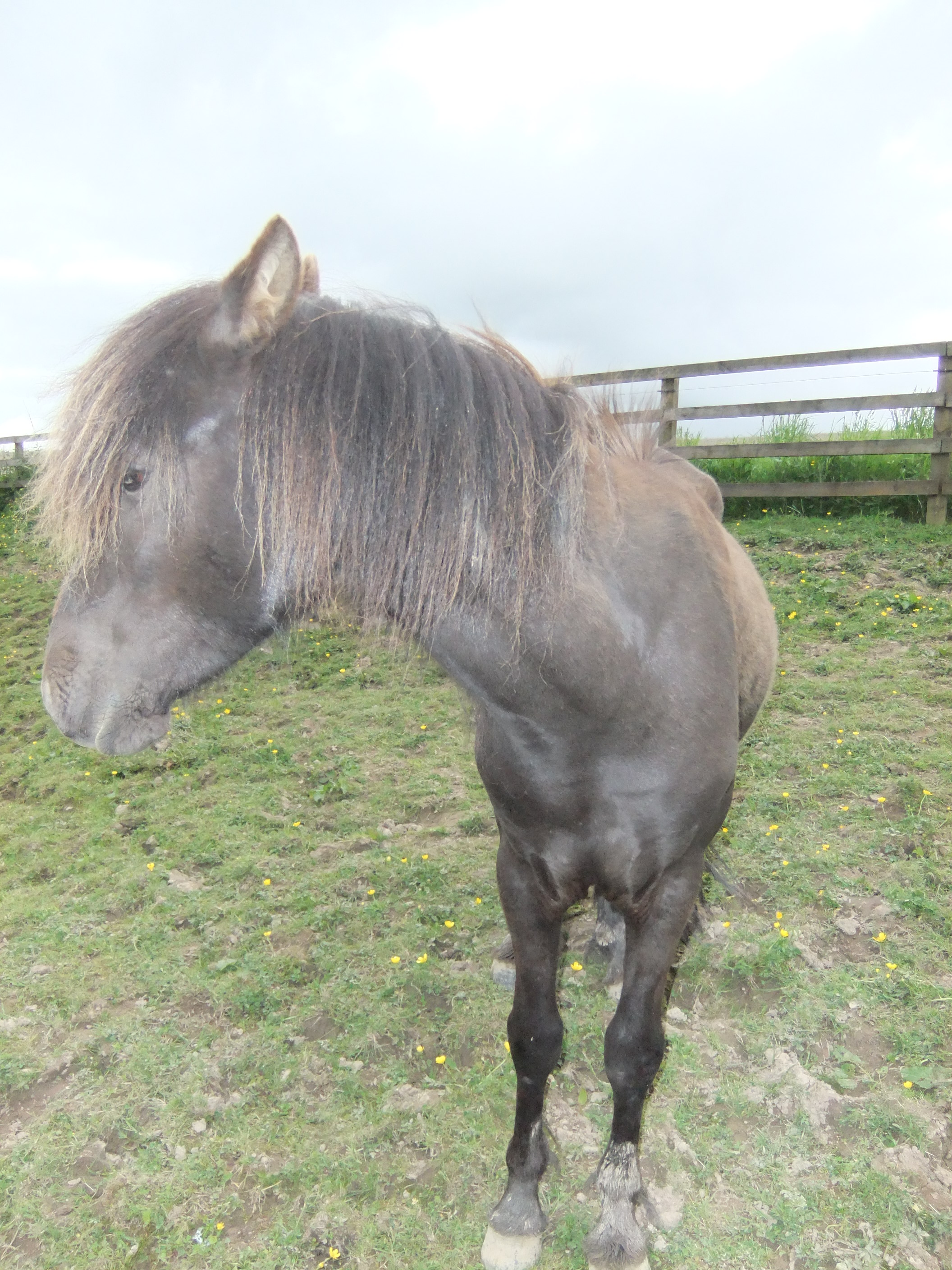
Last spring, I met some unusual and really delightful ponies. I’d read about them in one of the local papers in south west Scotland and was curious to find out more. They certainly looked right at home in the Scottish Borders, in the fields belonging to vet Sheilagh Brown where they live. However, their ancestors were used to the much hotter and drier, although equally challenging, environment on the Greek island of Skyros.  I discovered that the Skyros ponies I went to see have a long and interesting history.

Latest pictures1 011

Affectionate and curious, the Skyros ponies seek out the company of humans

The origins of the Skyrians and how they came to be associated with the island are lost in the mists of time, but they are certainly ancient. They are one of the breeds included in Elwyn Hartley-Edwards’ “Standard Guide to Horse and Pony Breeds” in which he mentions that parallels have been drawn with the horses of the Parthenon. The small horses on the famous frieze are clearly tough, fiery little animals. Looking at Sheilagh’s Skyros ponies, it seemed to me that there were certainly similarities; but the most striking thing about the Skyrians was their fineness. Their legs were clean and straight, their feet strong, dark and hard and the quality of their limbs would have graced any ridden show pony. I could also see similarities with the Caspian type of pony (or small horse).

Latest pictures1 006

A soft grey coat, which grows very quickly in winter, is typical of the ponies.

They are typically grey in colour, a rather warm-coloured grey with rose or dun tones. True dun is also frequently seen, and also a rich dark brown and a red bay, often with mealy muzzles. The breed description mentions a tendency to cow hocks but that wasn’t obvious in most of the ponies. In profile, their noses are straight and distinctive without any trace of concavity. They have broad foreheads and calm, curious eyes. From the start, they showed an interest in our arrival but they were neither pushy nor alarmed.

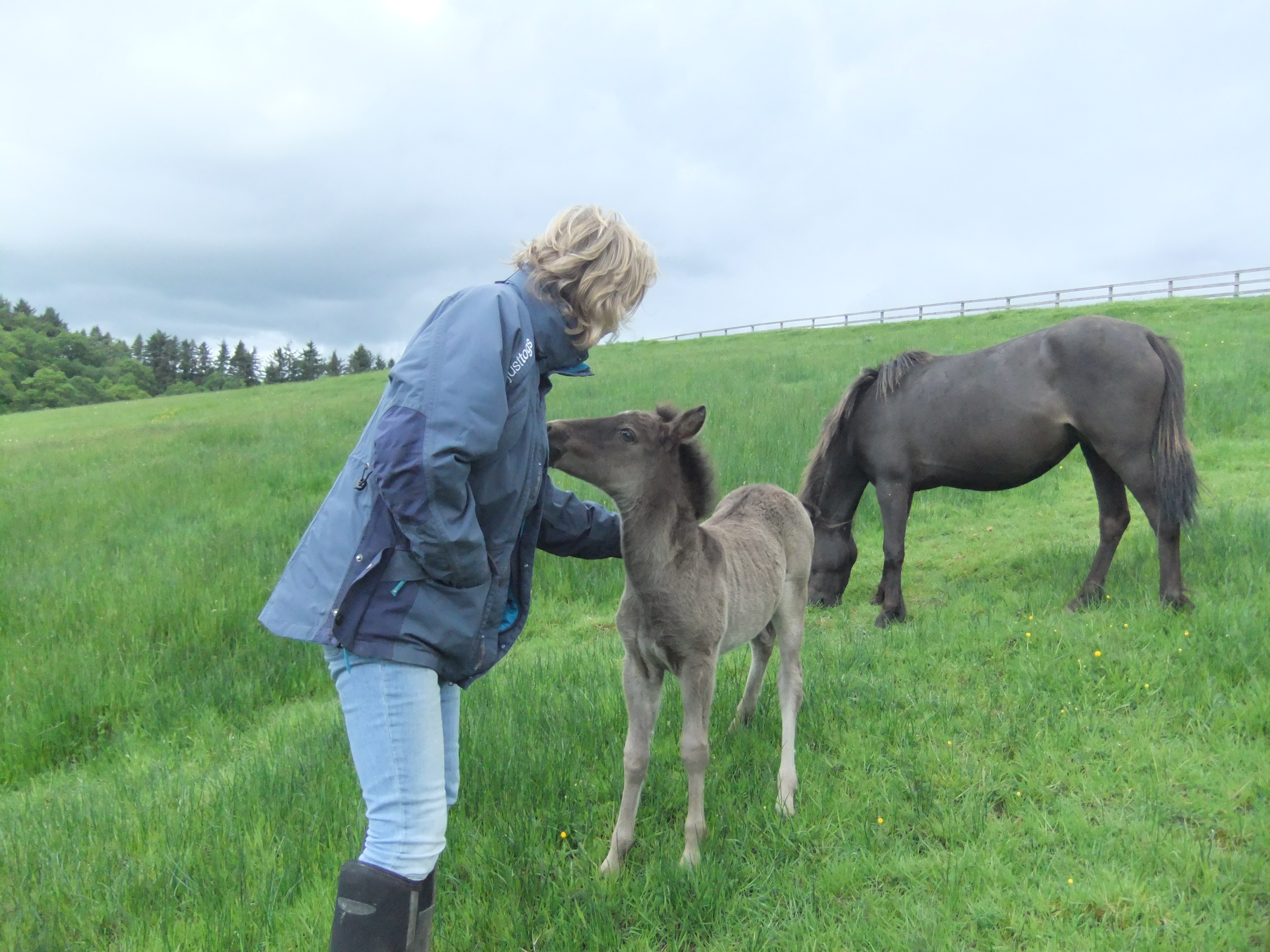
“That is one of the most noticeable things about the Skyros ponies,” explained Sheilagh as her gelding Danila (Danny) gave her an affectionate nuzzle. “They are very curious about humans and actively seek them out.  They are known for this sociability on the island.”

I soon learned that they are exceptionally docile and relaxed. The mares in particular realised very quickly that we were harmless and carried on grazing whilst one foal came right up to investigate us. Just as Sheilagh’s gelding Danila had done, the foal put his nose up towards Sheilagh in friendly enquiry. I was rapidly gaining the impression that the Skyrians bond quickly and their temperaments struck me as being ideal for ponies for small children.

Latest pictures1 019

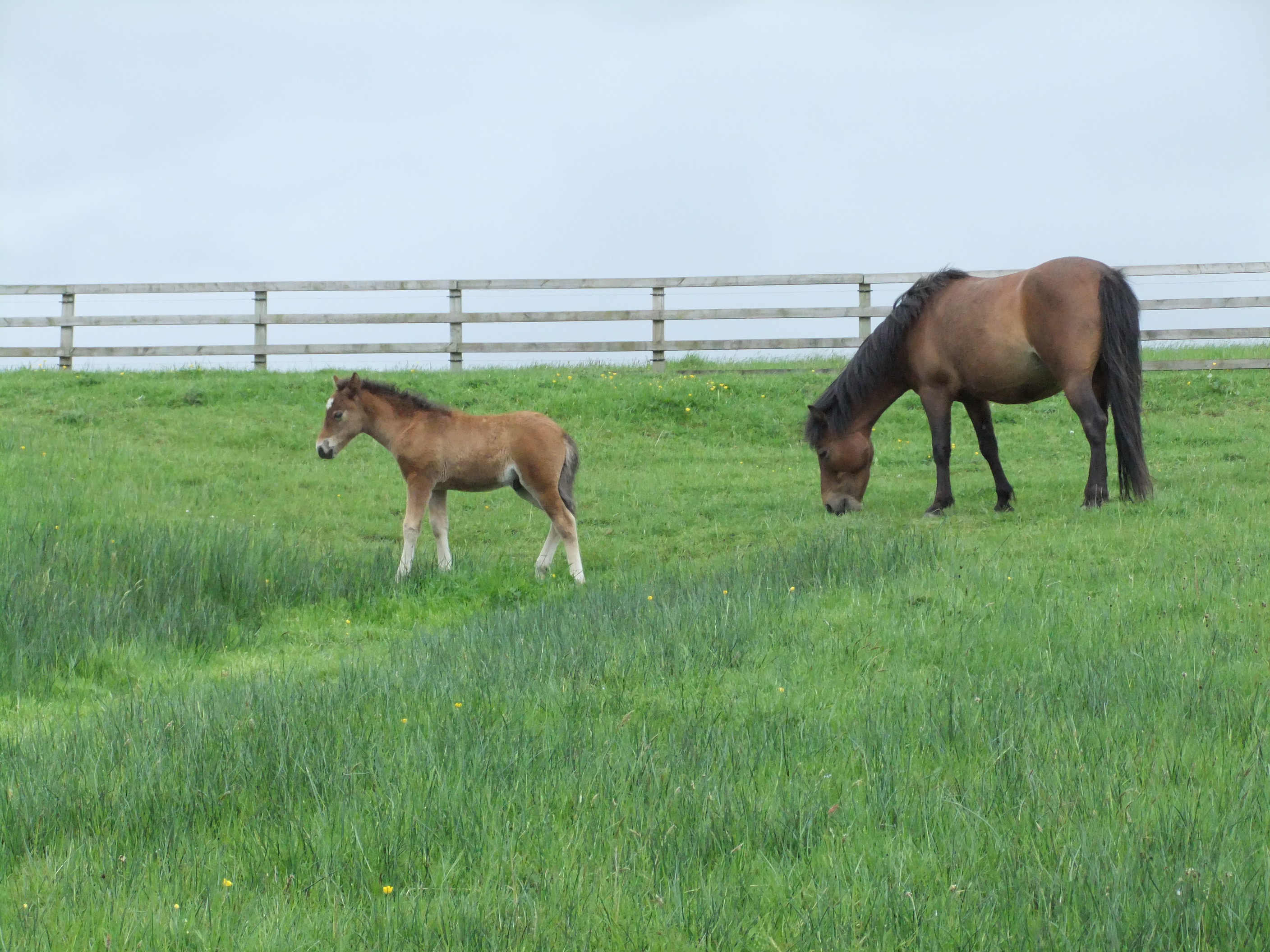
Looking right at home in the Scottish Borders – a Skyros foal and his mummy

Although the very early history of the Skyros ponies may prove difficult to discover, their more recent history is much better known. They were used for centuries in an unusual agricultural role. For most of the year they lived freely on the island, being brought in only during harvest when they were harnessed up to three or four together and used for threshing the corn. They would receive additional feed during the winter to help them survive. As in other places, when mechanisation took over, the ponies ceased to have a function and their future became very uncertain. As tourism began to flourish in the 1970s, various options, including racing, were attempted to ensure the continuity of the ponies of Skyros. However, as the 20th century drew to a close, it was clear that they were endangered and serious action would be required if they were to survive.

Latest pictures1 021

The foals are affectionate and curious, their dams calm and trusting.

And that is where the connection with Scottish Borders region comes in. Steps were taken on Skyros and on the Greek mainland to ensure the survival of the ponies and in 2005 five animals – three fillies and two colts – were brought over to Scotland by veterinary surgeon Alec Copeland who had a long-standing personal and professional interest in the Skyrians and other endangered ancient types such as the Exmoor pony. By 2010, when the Skyros ponies came into the care of Sheilagh so that Alec could concentrate on some of the other endangered breeds, their numbers had grown to 14. A further eight foals were born in Scotland in 2011. In 2012 there were another four births, but one foal sadly died. Two surviving colt foals are those featured in the photographs accompanying this blog.

I wondered how the ponies coped with the Scottish winter. The season can be harsh in their homeland too, of course, but the recent bitter winters with deep, long-lasting snow that we’ve seen in the UK have been exceptional even for Britain.

“They do grow a thick coat,” said Sheilagh (and the remnants were still visible when I went to see them in May last year). “They also need a lot of supplementary feeding in the winter. I’ve found that Dodson and Horrell stud cubes provide the best all round nutritional support for them.”

Latest pictures1 016

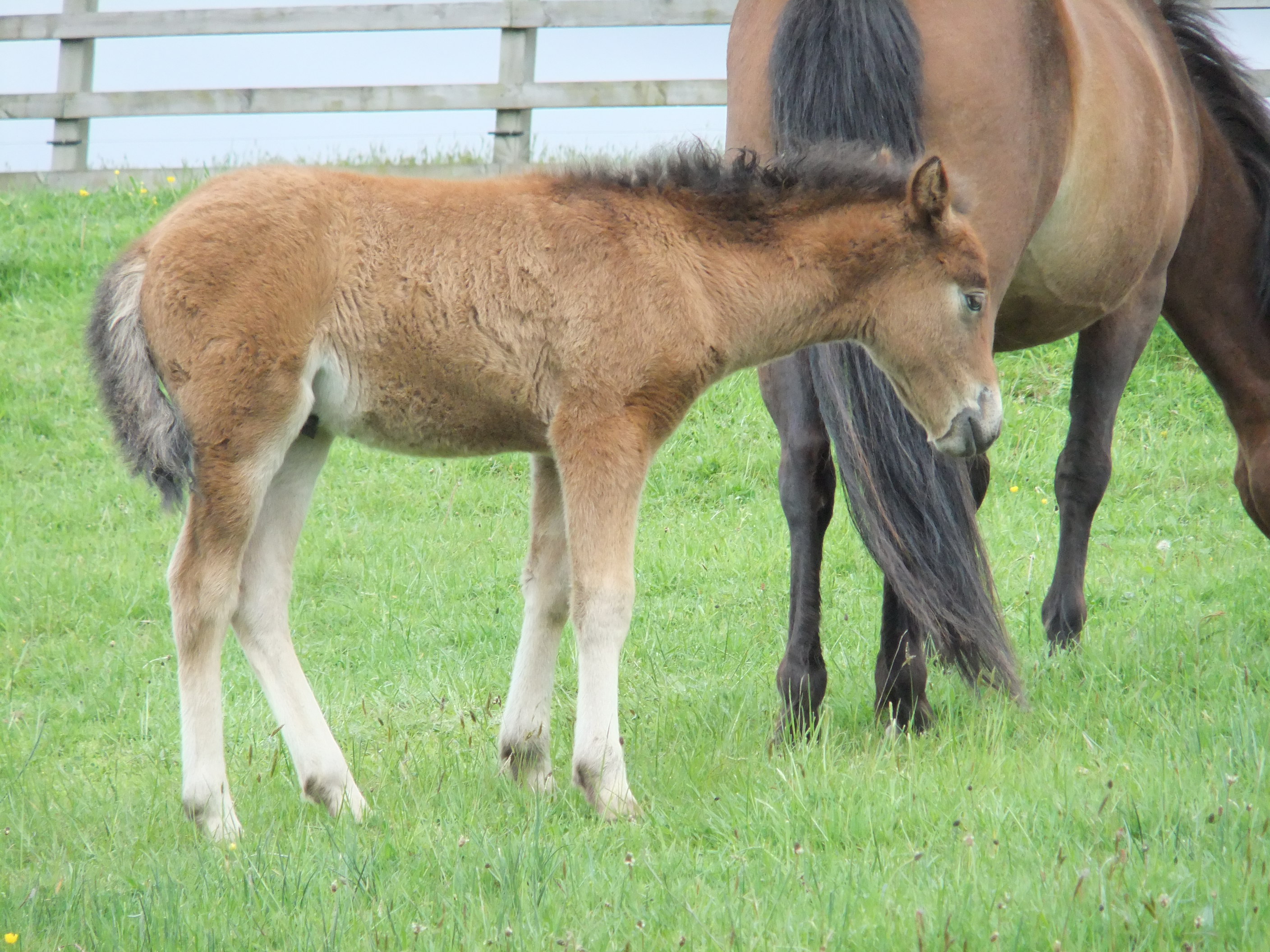
This colt foal shows the mealy muzzle that some of the Skyros ponies have

Sheilagh advised me that the Skyros ponies have been the subject of several scientific papers and were believed to be entirely separate from the seven known breeds of the Greek mainland. It has been concluded that they are phenotypically unique, and of course equids that have lived for centuries – possibly even millennia – literally in isolation on an island provide a very rich subject for investigation. However, funding that was provided for a time by the Greek government in order to support this endangered breed is now no longer available and the few projects, such as the Silva Project, that were attempting to ensure its survival now have to be self-sustaining.

These are uncertain times for all horses and ponies and in parts of Britain there is a serious equine welfare crisis. Sheilagh is aware that the horses and ponies with the best chance of survival will be those for which there is a genuine requirement. Clearly these unusual and little-known ponies don’t fit into any of the standard classes of use in the UK. There are no showing classes for them and their size at maturity (around 11 hands) means they are only suitable as ridden ponies for small, lightweight children. However, their outstandingly amiable natures are a real plus and I am sure they would make excellent, sensible driving ponies. There is one equine growth area where they are proving to excel, too: that is in the emerging field of equine assisted therapy and riding therapy. Shortly after my visit, Danny was off to his new home and his new role with an organisation called Festina Lente in Ireland. I wish Sheilagh, Danny, and the rest of the Skyros ponies all the best for the future.

Miriam Bibby

Harvey, Nero, Mr Allan Thomson and friends

Latest pictures3 018

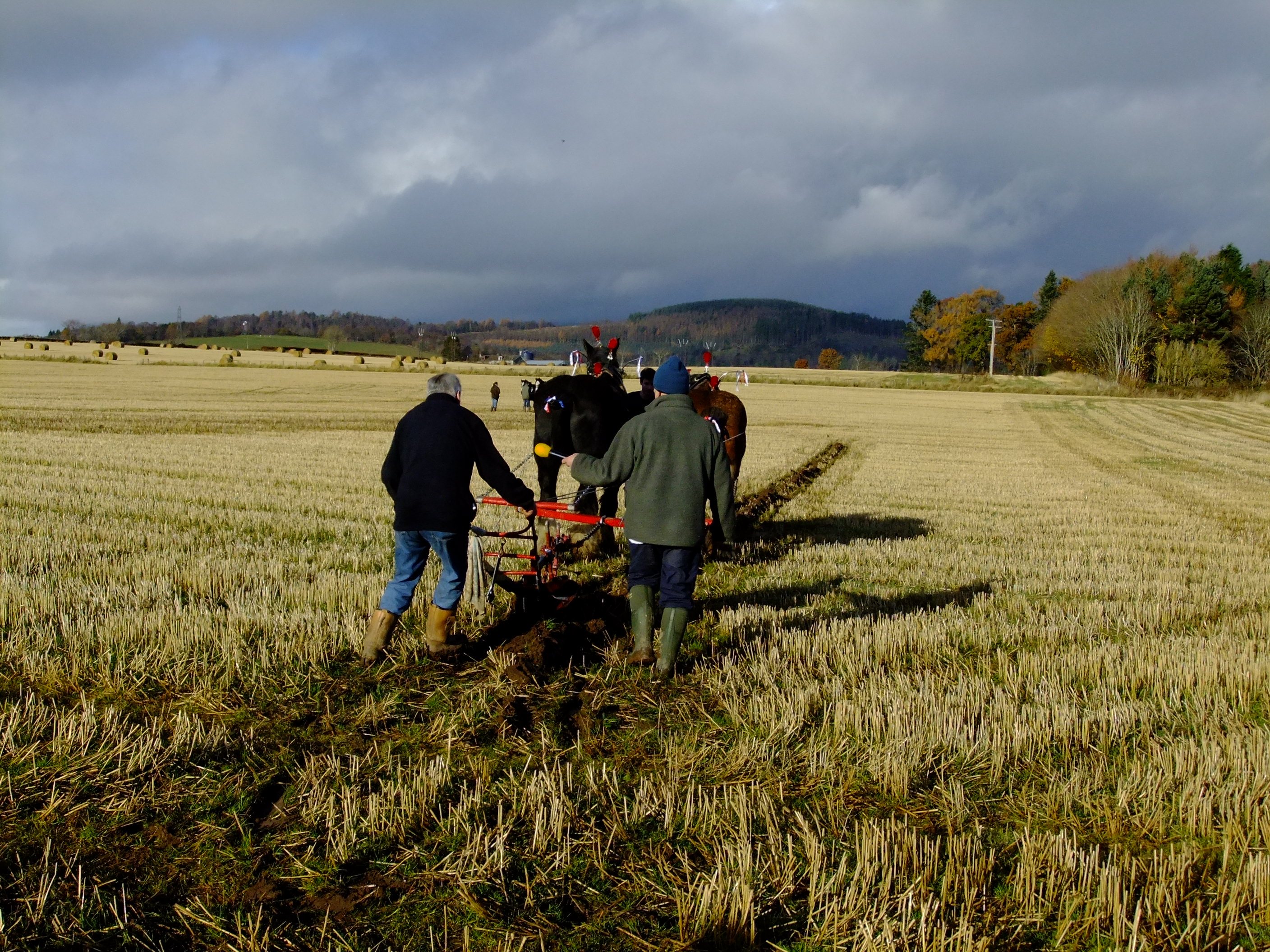
The ploughman (Mr Allan Thomson) and his commentator!

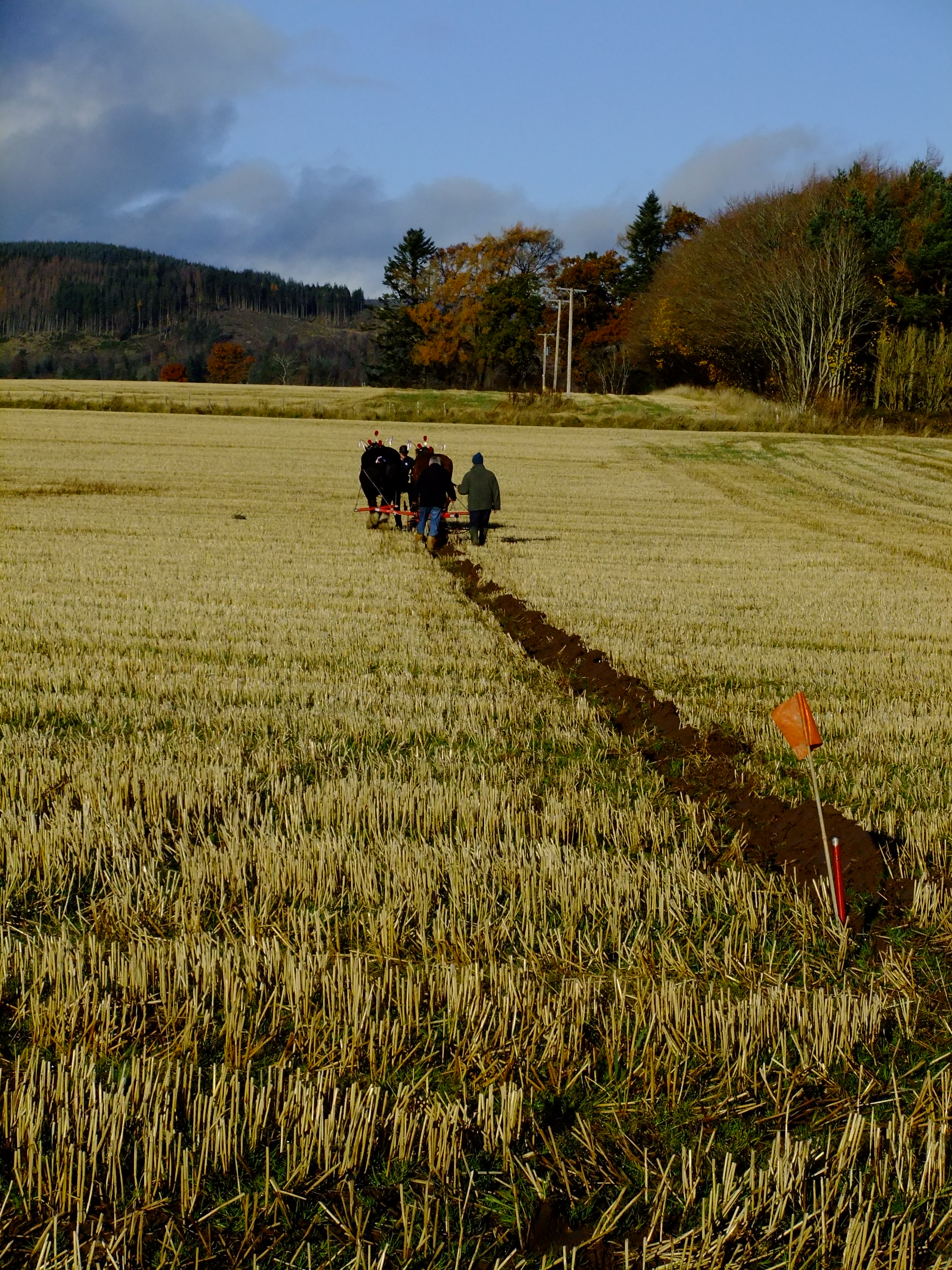
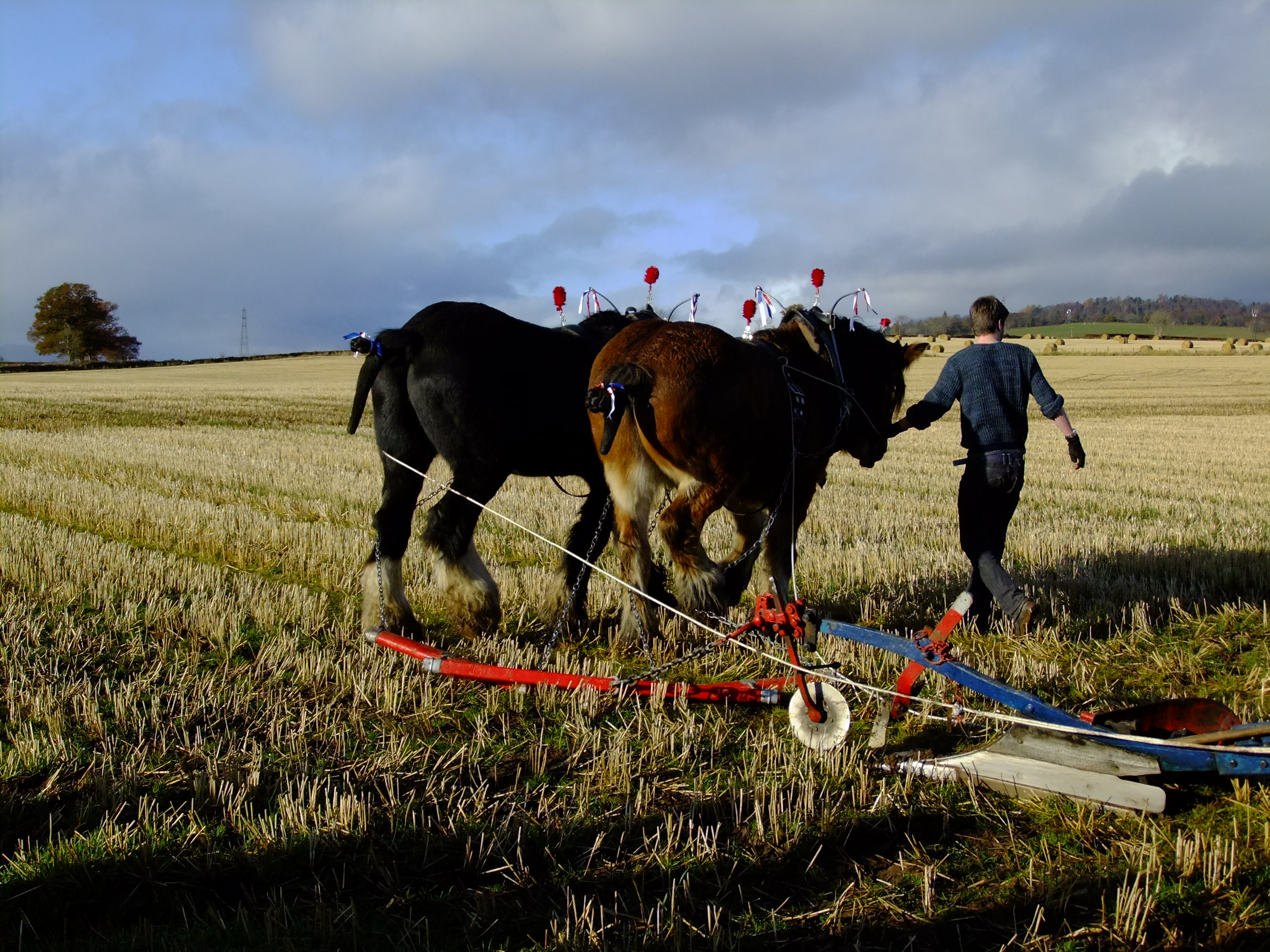
Pale golden stubble gleams under a blue November sky. A man is following two horses as they draw a plough steadily up the gentle slope of a hill towards a line of trees, sharp-cut and leafless on the horizon. Rooks and a gull or two pick insects from the black earth turned over by the ploughshare. This apparently timeless scene could be seen right across the British Isles from Domesday until the 1930s. Then, came the great change. Within a decade, the majority of horses had been replaced by tractors and the skills accrued over centuries by the teams who worked the land began to be forgotten.

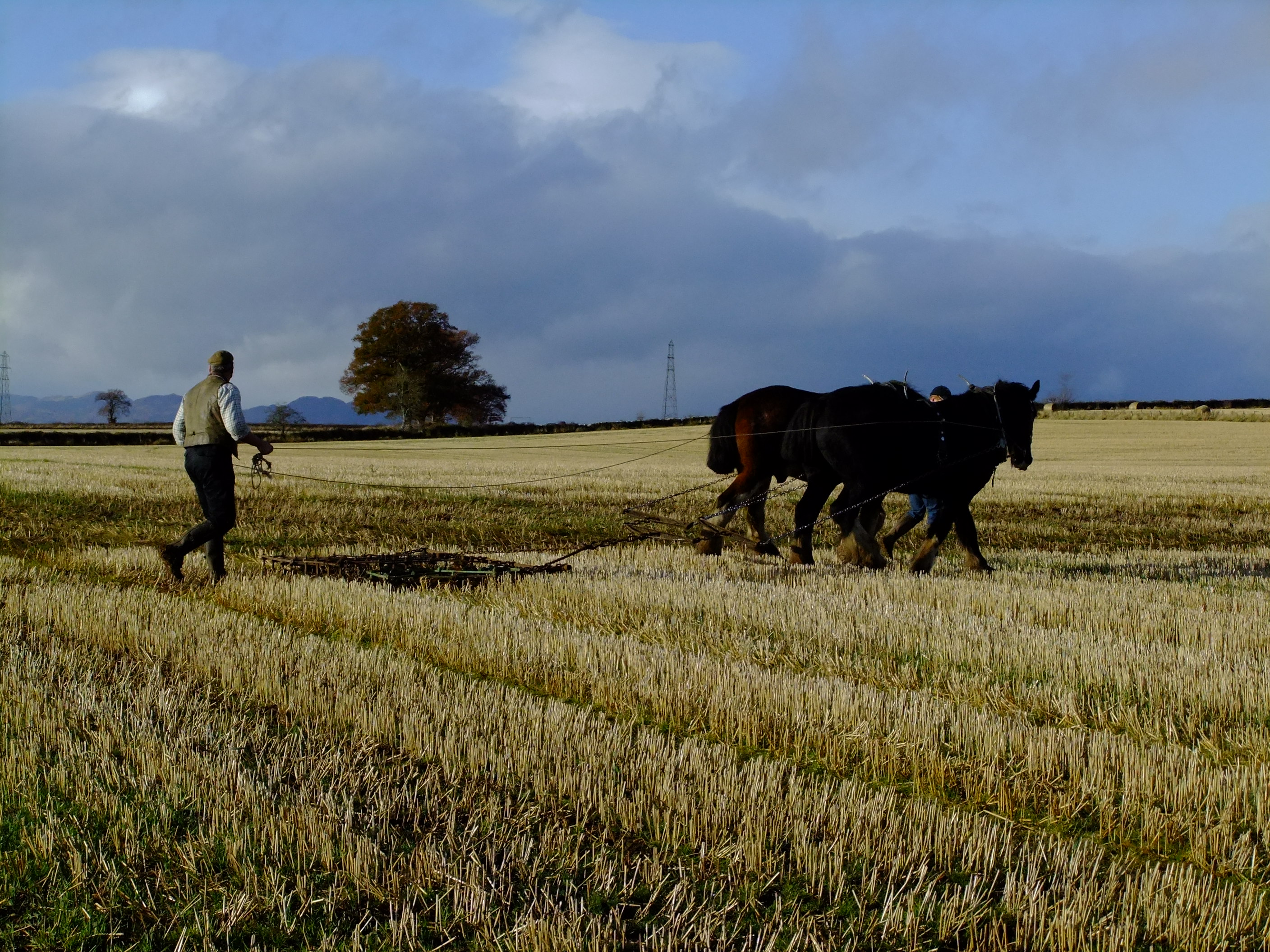
Latest pictures3 023

A classic scene; harrowing the land with a pair of workhorses

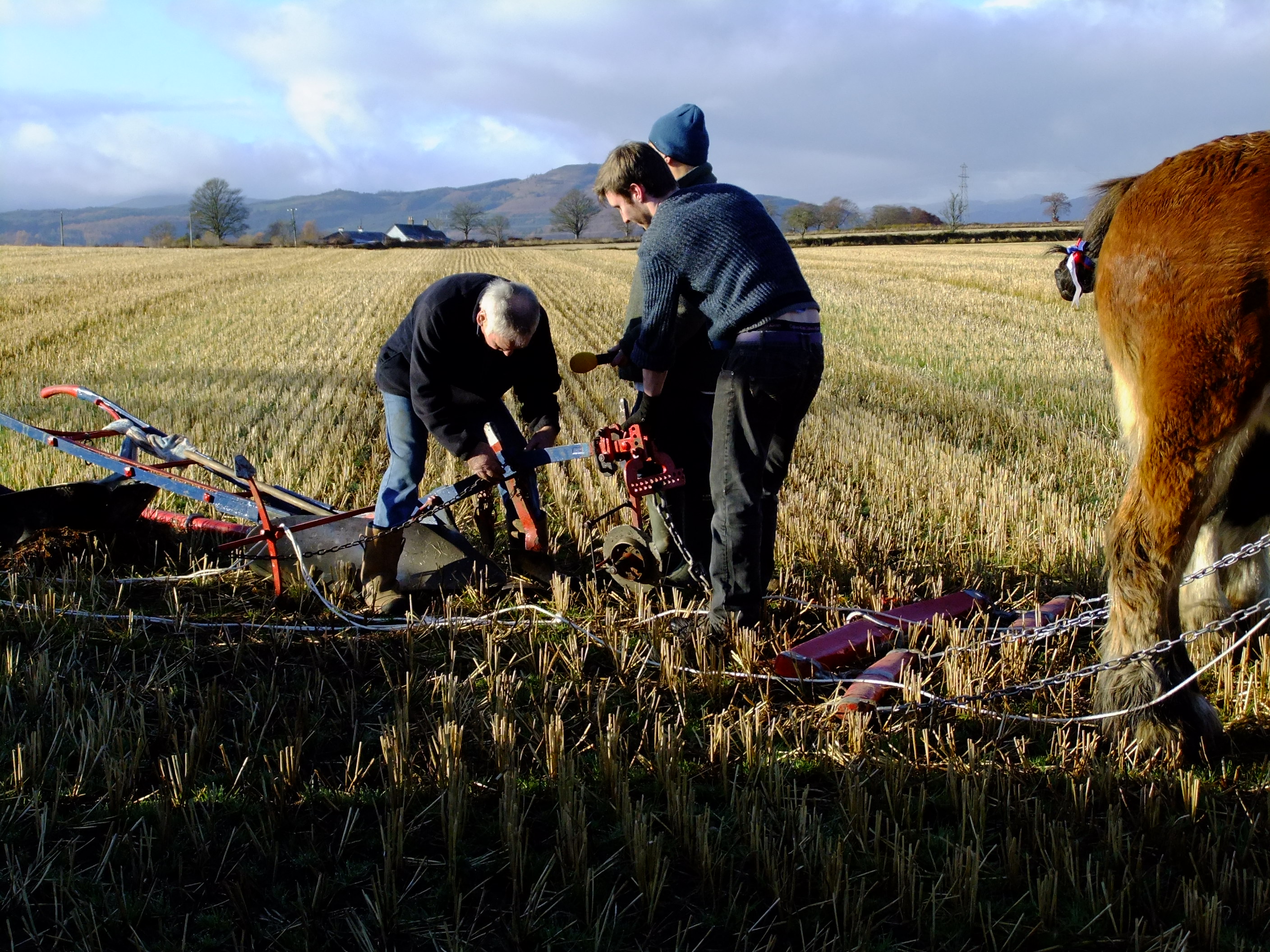
Latest pictures3 007

Setting up the plough ready for that all important first cut…

The ploughman and his horses would once have worked silently and in isolation in this landscape, moving back and forth steadily and slowly in march with the seasons. Today, though, he is accompanied by a lively and informative commentary coming over a speaker system to an enthusiastic crowd who are watching him at work. It’s the 17th of November 2012 and we’ve come from all over Scotland to observe, learn and perhaps apply some of the knowledge and skills that are on display here at this Working Horse Day organised by the British Horse Society (BHS Scotland).

Latest pictures3 010
Straight as a die…

What’s encouraging about this event is that it has not arisen from a nostalgic desire to revisit the past. It’s been organised because a substantial number of people have requested it. They want to learn about working horses because they are considering using them on smallholdings, market gardens and farms. They see a future for the working horse, not just a past.

Latest pictures3 017

Turning the plough…

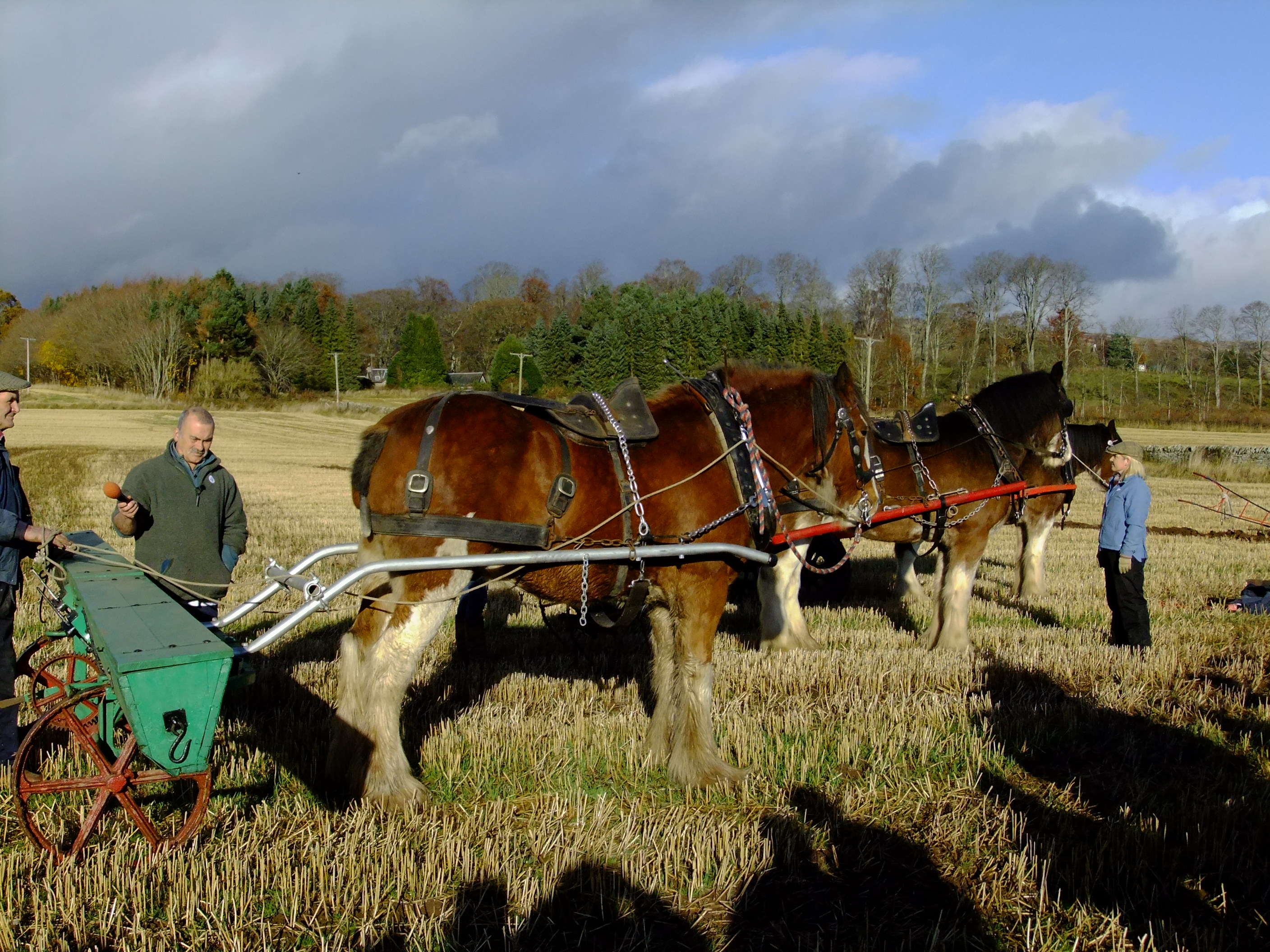
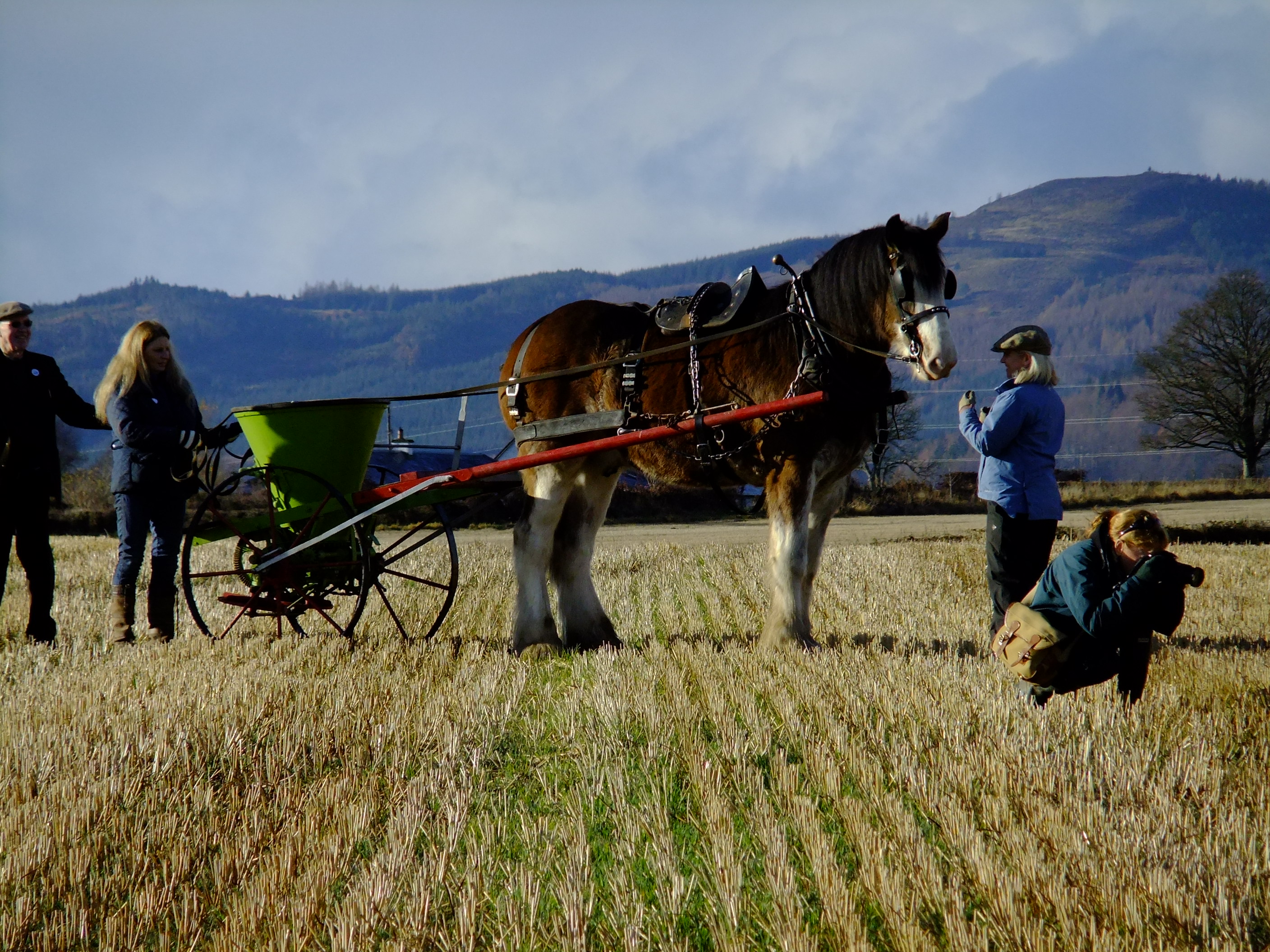
Whilst Mr Allan Thomson and his son adjust the ploughshare ready for their team to begin, another pair of horses are drawing a harrow across the field. The day provides a glimpse into the immense range of specialised horse-drawn equipment that was available to the pre-1930s farmer. Ploughs and harrows are core implements of course, but there were many ingenious individual engineering companies producing seed distribution boxes, muck and fertiliser spreaders, mowers, cutters, reapers and hay-rakes. And, appropriately for a country whose national bard is the ploughman-poet Robert Burns, Scotland led the way in a farming revolution for nearly 150 years. Burns witnessed the start of this revolution, but in his day following the plough was still largely a communal affair, with several people required to lend their weight to a massive iron-edged wooden implement drawn by teams of four oxen, up to six horses, or a mixture of both. Some younger members of the family would be needed to pick up stones from the path of the plough, whilst others would crumble the larger clods of earth manually and everyone would help in the pulling up of tough weeds and grasses.

Latest pictures3 034

In the heyday of the working horse, an immense range of equipment was available to the farmer. This long seed box is an example of the skill and ingenuity of the engineers of the period – and a tribute to the steadiness of the Clydesdale drawing it.

Iron was used sparingly in the production of the cutting parts of the plough until late 18th century developments resulted in the first entirely iron-framed plough, made by William Penny in 1800. It wasn’t just the expense and difficulty of the production of iron that had held back this development. There were superstitions about cutting the earth with metal and some believed that too much ironwork in a plough, other than the share, would poison the ground and affect the crops that were grown in it. Then, of course, there was the issue of keeping the ploughshare sharp.

Whilst Penny is credited with the production of the first entirely metal-framed plough, James Small, who preceeded him, was one of the most significant contributors to its development and is a major figure in the history of agriculture. Small, a Berwickshire man, devised a one-piece iron mouldboard and share that would create a much deeper slice and turn over the earth from the furrow onto the land beside it, which successfully suppressed the weeds and turned them into additional fertiliser. Crucially, this new design could be drawn by a pair of horses; at which point, also in the late 18th century, enter that legendary working breed, the Clydesdale. The image of the ploughman, his team and the ploughshare seemed indelibly impressed on the Scottish agricultural landscape. And the Clydesdale, that powerful, willing giant of the lowlands, not only worked the land, but was ubiquitous in the cities, delivering goods, drawing corporation and council vehicles, carrying items to the docks and railway stations for transport all over Scotland and “down south”.

It was not indelible, of course. The day of the working horse was drawing to an end in the 1930s and was virtually over by the 1950s. Certainly, one or two councils and larger companies – mainly breweries – held on to a pair or two, conscious of the eye-catching appeal of their magnificent turnouts – and, perhaps, conscious that there was an environmental aspect to it too. Horses could still hold their own in deliveries over short distances, but by the 1970s the sheer quantity of motorised vehicles on the roads made it dangerous and difficult for them to do so. Those were the years when we came closest to losing the working horse tradition altogether. The few members of the working horse breeds that survived seemed fated to a life as show-ring exhibits and little else.

“If it hadn’t been for the Co-operative – and Irish horse breeders,” says Mr Thomson, “there would have been no working horses at all.” At that time, he was involved in forestry work using horses and was finding it extremely difficult to find any suitable workhorses. Finding equipment was difficult too. “Things are a lot better now,” he continues. And, certainly, the day proves that there are some excellent working horses about, including those showing off their skills today. There are several fine Clydesdales present but a working horse can also be just a good ‘type’. For the work of the smallholding or garden centre, there’s no reason why a good working pony should not excel.

Latest pictures3 014

Harvey – clearly a character – on the left and Nero on the right.

Harvey, one of the pair that Mr Thomson and his son are using today, is Irish-bred and started out as a trekking pony. He’s clearly a character and has taken well to his job as a plough horse. Mr Thomson explains that both he and his ploughing partner Nero are now in their early twenties and “we’re just getting them the way we want them.” This is, without a doubt, the greatest thing I have ever heard from a horseman. It takes time and patience to build the relationship, whether you are teaching a horse to draw a plough or perform in the Spanish Riding School, whose horses are also often in their prime in their teens and twenties. Be ready for the long haul, put in the effort and you’ll be rewarded with long term success. And treat your horses kindly, as partners, not slaves or machines. That was the message of the old horsemen, who believed they and their horses were one.

Latest pictures3 026

Traditional hopper style feeder, useful for a variety of tasks on the land.

Allan Thomson gives us a quick overview of the harness, including the blinkerless bridles  – “I use open bridles, I prefer them” – and the plain, thin snaffles that are attached to them. Chains are used to link the collars to the swingle-type attachments in front of the plough and the thin ropes used for guiding are known as ‘lines’. A rope is laid on the ground to mark out that very important first cut and the pair are off. We watch as the cut opens neatly and earth turns over onto the land, as cleanly and impressively as slicing a well-baked loaf. As the plough swings round and returns, there is one horse in the furrow and one on the land. Mr Thomson explains that during the first world war, with man – and horse – power in short supply at home, the two-furrow plough, drawn by three horses but needing only one ploughman, became popular.

Latest pictures3 041

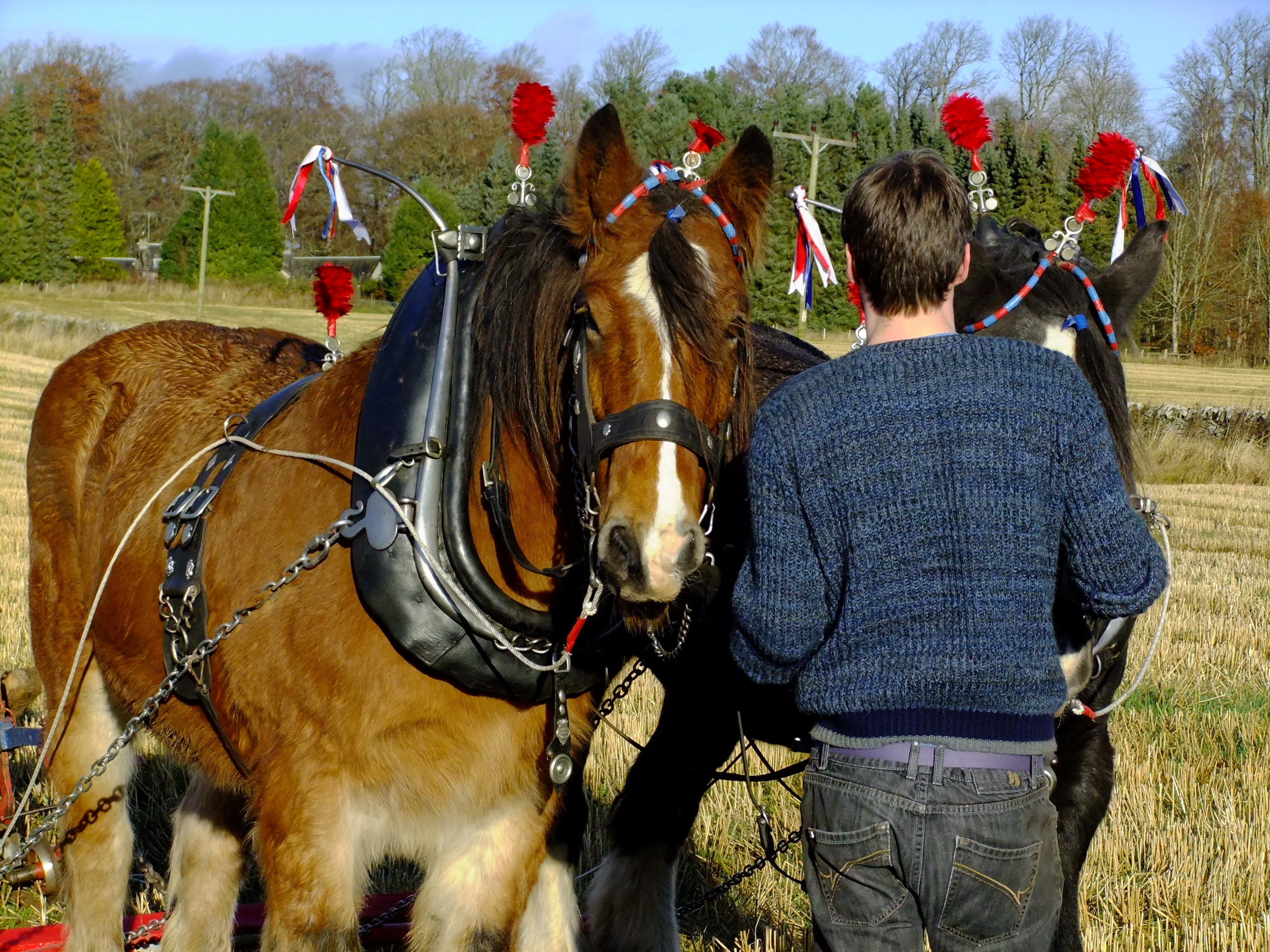
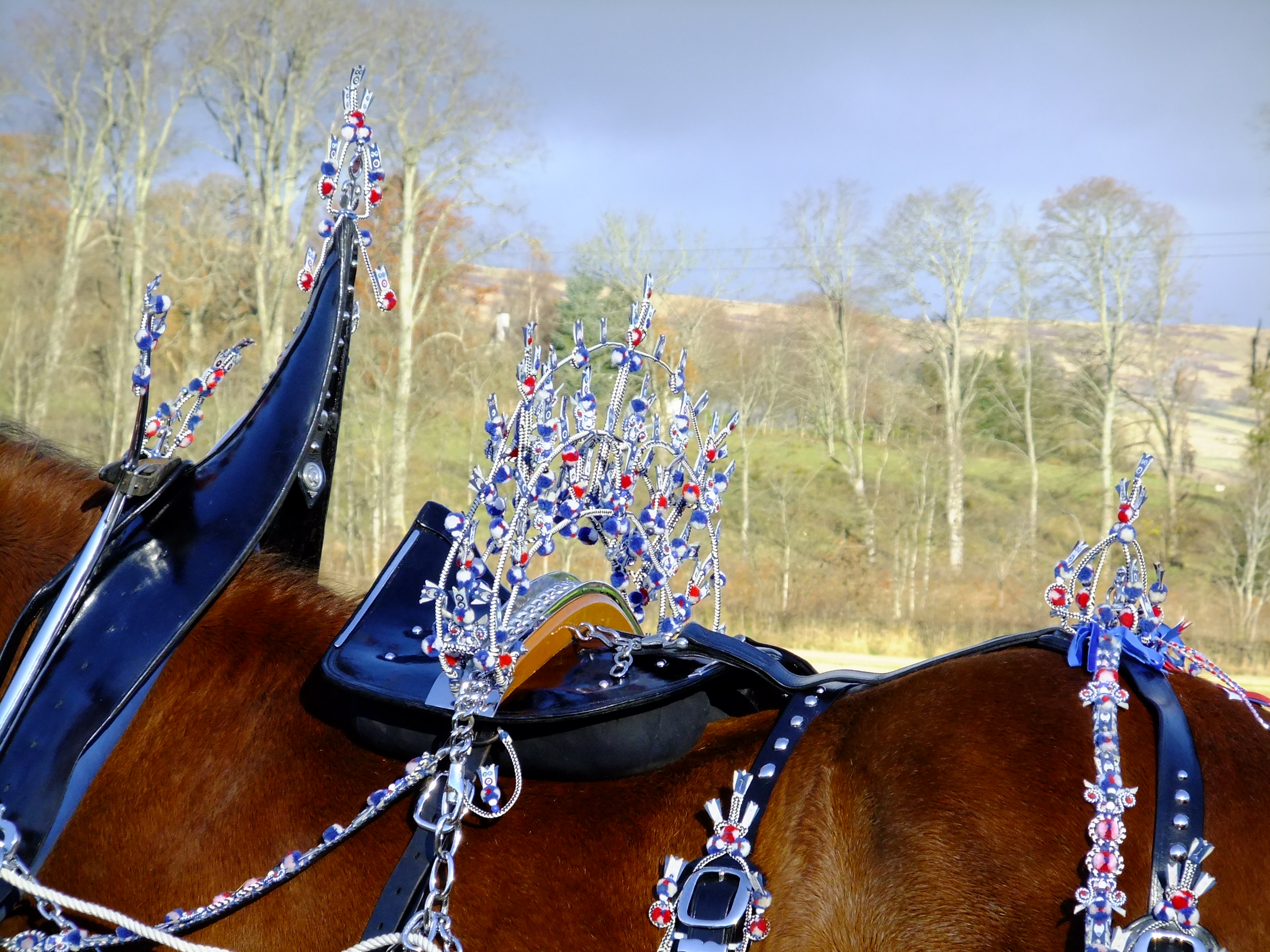
The magnificent traditional chrome and leather harness, with its blue, white and red decoration, takes hundreds of hours to prepare.

On the rare occasions when farm horsemen had time off, their horses were still involved in their lives. Beautifully turned-out individuals and pairs of working horses were popular exhibits at agricultural shows and there was a great deal of rivalry in the show ring. Undoubtedly one of the most popular sights of the Working Horse Day is a magnificently turned out young Clydesdale, decked in traditional manner in chrome, blue, white and red.  He is wearing the high, pointed collar with gleaming chrome hames that is associated with Scottish tradition. The commentary explains that originally the intricate harness decoration was coloured blue and white for the Saltire of Scotland; and that red was added after the coronation of the current monarch. A crown is now one of the symbols included in the decoration. We learn that it takes hundreds of hours to complete the decoration on the harness and that there is now only one man in Scotland with the knowledge to do the complete turnout.

And this becomes the lasting legacy of the day, for some of us. Let us not let this working horse knowledge and experience disappear. It deserves not only to be remembered, but also to be practised. Let’s make sure that the working horse tradition continues, in the hope that in the future our horses can work alongside us as partners, in the methods of the best of the horsemen of the past – and present.

Horseback Historian would like to thank Mr Allan Thomson and friends (and horses) for sharing their knowledge and experience during the course of a very memorable day; and thank you to BHS Scotland for organising the event. I hope that there will be more.

Equine boom – and bust

When I was very young, I lived in the city of Newcastle upon Tyne in north east England. Newcastle lies at the eastern end of Hadrian’s Wall and it has a long and interesting history. It has always been an industrial – and industrious – place. In Tudor times, coal from Durham and Northumberland – a major national commodity – was shipped  from Newcastle to London. Newcastle flourished during the 19th and early 20th century; and like all major cities, part of the reason for its success was the labour provided by thousands of work horses.

Whenever we drove through one particular part of the city, there was an appalling stench.

“That’s the glue factory. It’s where they send all the horses when they die,” said my father, glancing across at me slightly anxiously. He knew I loved horses.

“That’s horrible!” I said. I think I was pragmatic about it, though; I understood that horses grew old and died and that something would have to be done with their remains.

The full significance of what he was saying did not really strike me for decades.

A world of horses

Horses were part of my life. There were always horses; ponies in the riding school whose customers trotted over Newcastle’s Town Moor, the city’s green lung; ponies on the beaches of the seaside resorts along the coast of Northumberland where we went at weekends; ponies tied up by travellers on patches of common land – the sweetest, most well-behaved ponies I have ever known – and, yes, even a few horses that still pulled vehicles around the city streets, mostly belonging to the “rag and bone men”, the urban recyclers of the mid-twentieth century. At that point, a few ponies were still in use in the mines of the north, Scotland and Wales. Even the shepherds on farms along the Border used horses or ponies, not quad bikes.

Our coal was brought for a time by horse and cart. The old horse, named Cassius (probably after the boxing legend rather than the character in Shakespeare’s “Julius Caesar”), had a bad temper but still received an apple or some sugar from me. Whenever we went to a cafe, I would raid the sugar bowl for paper-wrapped sugar cubes, taking as many as I dared, because I knew there would always be another horse to feed. The story of the first time I’d been on a horse’s back – that of the milkman’s horse, Spot, when I was a toddler – had become family legend. As late as the 1970s people could still relate to Benny Hill’s ludicrous ditty about the showdown between Ernie the milkman “who drove the fastest milk-cart in the West” and his rival “Two-Ton Ted from Teddington” who drove the baker’s van. Horse-drawn in both cases, of course. Did you know it’s one of the favourite songs of both David Cameron and Earl Spencer, the brother of Princess Diana? They both included it in their “Desert Island Discs” selections. Bizarre but true; and it shows how deeply the tradition of the working horse is still embedded in the British psyche.

There were showjumpers on the telly and horses in westerns. There were books about ponies and gymkhanas – a world away from the one I lived in, but one I always envied and to which I aspired. There was televised racing from Sandown and Uttoxeter and elsewhere and I couldn’t understand why one horse called “Bar” seemed to be in every race until it was explained to me. There had always been horses. There always would be horses…

In fact, during the 1960s and 70s, there was serious, pessimistic talk about the forthcoming “extinction” of the horse. Those rag and bone men still jogging round the cities of Britain on their worn-out old carts, with their strangled, almost incomprehensible street cries “Raaaaa-aaa-booooone!” were just about all that remained of the working horse tradition. The desire of the young to escape the shackles of the past was encapsulated in the well-observed television comedy, “Steptoe and Son”. Aged dad Albert, with his fingerless gloves, junk-filled house, horse-drawn rag and bone cart and memories of World War I, symbolised everything that his aspirational son Harold wanted to escape – or even bury. However, Harold was fond of Hercules, the horse; and the references to him were always filled with warmth and humour. The scenes with Hercules were touching and sometimes moving.

I didn’t understand at the time, but my father had been telling me that the stink from the glue factory was the stench accompanying the last gasp of the working horse tradition; the betrayal of centuries, millennia in fact, of human dependence on equine power.

Horsemeat: by-product of technological change

When little Miss Combustion Engine, wiggling her sexy exhaust, walks onto the block with all her family – the juggernauts, the 4W-Ds, the vans, the limousines – humans can’t move fast enough to send their loyal horses to the knackers. Horses become an embarrassment, like an aged relative drooling dementedly in the attic. In  Ireland during the Celtic Tiger years, Dublin’s famous horse market at Smithfield was quickly moved out of the city centre. Horses are dirty and demanding. They are too slow. They aren’t powerful enough. They are expensive. They are dangerous and a nuisance. Logically it could be said that cars are also expensive, dirty, demanding, dangerous nuisances; and if you’re stuck in city traffic or a motorway jam it doesn’t really matter how fast or powerful your car is. And there’s many a farmer who is overwhelmed by the debts accrued from purchasing and maintaining tractors and other equipment. However, this isn’t about “logic”. It’s about “progress” and “convenience”.

The change from equine to motorised power (and the resulting collapse of established industries, to be replaced by new ones) provided an important example for the work of the economist Schumpeter, whose theory of “creative destruction” described the consequences of rapid and extensive technological change. Old industries collapse, but others arise from the ruins.

The most important aspect, for me, of the recent “scandal” over horsemeat in the UK came to light during investigations into the origins of the meat. It appears that the sudden influx of horsemeat on the market is due to horse-drawn vehicles being banned from main roads in Romania. In other words, it marks the the end of another working horse tradition, in this case in eastern Europe. When the tradition came to an end in the USA and UK, the carcasses of the slaughtered horses were used for pet food and the remnants were rendered – hence the glue factory.  Now, in a global economy, the end of the working horse means the production of a commodity – horsemeat “stuff” – that has the potential to end up anywhere.

I don’t eat meat but I’m not being smug about this. If you eat meat, I don’t see why eating horse is different from eating any other kind of meat. What I don’t understand is how unconcerned some people are about what they are eating; and that somewhere along the way, someone has lied. There is a difference between eating meat that has lived in the wild, or originated from well-documented sources which show the treatment, food and medicine that animal has received – and eating meat stuff that is just that – “stuff” – without knowing – or caring – what it really is or where it came from.

The equine boom…

The horse didn’t become extinct, of course. What saved the horse in several parts of the world was the rapid emergence of the predominantly female leisure rider. For some, aspiration didn’t consist of getting rid of a horse, but was expressed through acquiring one. The boom years of the leisure rider (in the UK) began in the 1960s and probably peaked in the 1980s, when women (and men) from many different backgrounds started to keep horses simply because they wanted horses in their lives. They weren’t necessarily wealthy. They didn’t necessarily come from families with a long tradition of equestrianism. They just had a bit of money and some leisure and they intended to spend both on horses and with horses. And boy, did it boom!

Equestrian clothing manufacturers, saddlers, rug makers, horse breeders, show and event organisers, horse trainers, riding schools, livery yards, magazines, specialist publishers and authors, societies, farriers; horse feed, hay and haylage producers; vets and veterinary products: all benefited from the boom. In the mid 1990s, it was estimated that the equestrian “industry” in the USA was worth 15 billion dollars annually.

I was part of the boom. I bought my first pony, became a journalist specialising in equestrian subjects and spent a lot of my time participating in, observing and commenting on the equestrian leisure boom. Some of its aspects were a bit silly, it seemed to me. I called it the “pink bucket” phenomenon, as a range of supposedly girly equestrian accessories hit the market. Horses hadn’t become extinct, but they had certainly changed. The working horse tradition had been largely, if not exclusively, a male world. Now, horses and ponies were mainly kept by women and girls. Along with the silly accessories and over-emphasis on performance in the showring, there were some good times and indeed some great times. And when all is said and done, it was mainly women who kept equestrian traditions alive and supported the “industry” through that time. Horses survived, thanks mainly to the money and energy of women. Also, to those who were dedicated to horses for other reasons, some horse breeders and working horse centres for instance.

…and bust

In 2013, the equine boom in the UK is clearly at an end. There is a welfare crisis as people desperately try to find homes for horses and ponies they can’t keep. For some, it’s a cost they can simply no longer afford. Others perhaps feel older and wiser after years of horse keeping and just want a change. They don’t want to spend their time and energy on horses any more but on something else instead. Riding schools are closing because of the costs; and, allegedly, because of the risk of hefty insurance claims and the restrictions of health and safety rulings. In Egypt, too, there’s an equine welfare crisis, for different reasons. The collapse of tourism after the Egyptian revolution means that many of the small businesses in Egypt depending on horses – particularly the ubiquitous tourist site carriage drivers – are in dire straits. In the 1960s, people were saying that the horse would be extinct by the year 2000. Did the equine boom simply delay it by another decade or so?

I don’t think the horse will disappear entirely. There will always be some people who will dedicate themselves to horses despite the costs in terms of time and money (and the emotional cost, too). They’ll take the odd looks and the critical or joking comments about horses being a waste of space, grit their teeth and carry on, because horses are what they do and horses are part of who they are. Sometimes they’ll wonder why the hell they’re doing it and then, on a bright day in summer, their horse will come cantering across the paddock towards them and they’ll remember.

A future?

Throughout my life, for as long as I can remember, people have been talking about the possible return of the working horse. That’s what it’s been mostly – talk; but not entirely. In the 1970s, television director and producer Barry Cockcroft made his famous documentary about Geoff Morton, one of the few remaining people in Britain to still use horses on the farm. A book, “Princes of the Plough” further chronicled Morton’s life and that of some of his contemporaries. It spoke optimistically about a future for working horses. A few councils and large commercial organisations used – and continue to use – working horses for deliveries; and to turn them out impeccably for shows. Sometimes this is because they are aware of the promotional opportunities horses provide, but in some cases the organisations simply never stopped using them. And there are others; the journalist Paul Heiney, having learned about working Suffolk Punches for a 1980s reality TV show, decided to buy some working horses of his own. Working horses are still used by the British Horse Logging Society. There are a few individuals, both men and women, still using horses in farming and in other businesses. Carriages for weddings are particularly in demand. Horses are used in television and film work – where would a Jane Austen series be without a carriage and pair? How would the “Lord of the Rings” movies managed without Shadowfax? Gimli walking along behind Gandalf making clippety-clop noises with some coconut shells, Monty Python style – that’s how; though I suppose CGI could fill the gap.

Ought there to be a major return to working horses, anyway? After all, when they did all the “lugging and dragging and straining”, to quote H.G. Wells, their lives were often nasty and short. I suppose I’m still pragmatic about this, because it seems to me that when humans don’t have a need for something, they don’t care much about it: therefore the best future for horses might be as working animals. And perhaps, there are reasons to be “cautiously optimistic” about this future, as I’ll discuss in the next blog. “Cautious optimism” seems to me to be better than boom and bust, anyway.

Miriam Bibby

Egyptian horses, chariots and bows: metaphors for control

Walk into any major Museum collection and Egyptian artefacts are easy to spot. We might say it has a strong brand!  We know that mummies, coffins, sarcophagi, pyramids and strange gods with animal heads atop human bodies are some of the items that instantly say “Egypt” to us. Plus, the curious sacred writing, the hieroglyphs, which may mislead us at first into thinking this is a pictorial script in which each picture represents an idea, concept or word.  (This is not the case.) Only after some time might an observer become aware that some of the imagery – the iconography – of the kings of Egypt includes horses and chariots – and bows. The best known king of Egypt, Tutankhamun, is represented several  times mounted on a chariot. His fabulous funerary treasure, now in the Egyptian Museum, Cairo, includes a large gold fan depicting on one side the young king hunting ostriches in the desert and, on the other, his return with the bodies of the birds he has skilfully shot with his bow. His two servants stagger along under the weight of the ostriches. Other vigorous and dramatic images on an inlaid box show the king and his chariot as an enormous, dominating presence relative to the other elements of the scene. On the lid, many different kinds of wild animals, including asses, are shown fleeing in front of him. On the sides, the superhero king overcomes his Nubian and Syrian enemies. Despite the pleading demeanor of these enemies, tiny under the bodies of the rearing horses, the king is about to crush them to death.


As far as we know, this imagery and these artefacts were made specifically for Tutankhamun’s burial in the Valley of the Kings. This shouldn’t be taken for granted, as it is certainly the case that items made for a particular royal individual often ended up in the burial of another relative. However, further investigation into the funerary artefacts of other Egyptian rulers reveals a decidedly repetitive element. Again and again the king, whichever king it is, appears in a pose generally known as ‘smiting the enemy’. He is mounted in his chariot with a bow, or occasionally a sword called the ‘khepesh’, overcoming his enemies who are never shown with any potency at all. Sometimes the ‘enemy’ is represented by wild animals or birds. Were all these kings truly superheroes who had rescued their land from its enemies? What is the significance of the overcoming of wild beasts?

‘Smiting the enemy’ is a piece of very ancient Egyptian iconography.  It is at least as old as the Egypt that emerged from the unification of two separate geographical entities (the Delta and the Nile Valley) in 3100 BCE.  It appears on an extremely important Egyptian artefact of very early date, the palette of King Narmer, who is shown lifting a macehead to crush the skull of an enemy who kneels defeated at his feet. Actual maceheads are known and they are important ritual and symbolic artefacts of great size, containing imagery that gives us tantalising glimpses into the foundation of the Egyptian state. Violence, or the threat of violence, is part of the maintenance of authority right from the start. The difference between the semi-legendary Narmer and Tutankhamun, who reigned nearly 2000 years later, is that Narmer is on foot, whilst Tutankhamun and the other rulers of the New Kingdom have horses and chariots; and tend to wield bows or swords rather than blunt instruments.

The innovative, creative ancient Egyptians, to whom we owe so much relating to the development of architecture, agriculture and medicine, amongst other human activities, did not play a part in the early development of chariotry. The origins and progress of chariotry technology across the ancient world is still a rich field for researchers. Two pioneering scholars in this field, Mary Littauer and Joust Crouwel, also produced an outstanding volume on the chariots of Tutankhamun. This is published by the Griffith Institute as part of a series on the artefacts from the tomb.  Several chariots, amazingly robust, delicate in appearance, and sheeted in gold, were included amongst the treasures in Tutankhamun’s tomb. They had been dismantled, like flat pack furniture, to take into the tomb, providing a marvellous investigative opportunity for the two researchers whose volume accordingly tells us a great deal about the construction of these vehicles. Prior to the middle of the second millennium BCE, the ancient Egyptians had no knowledge of the horse or chariot; wheeled vehicles played no significant part in their culture and the River Nile was the highway of the country, carrying goods and people from the Delta down to the Nubian border in the south and vice versa. Prior to 1650 BCE the horse was apparently not known in Egypt; it appears only once before this in a late Middle Dynasty tomb in the delta that is something of an anomaly. (The arrival of the horse in ancient Egypt, and who brought it, is a complex topic that is still the subject of discussion.) Along with the chariot, the earliest examples of which are to be found at Sintashta in Kazakhstan, came the compound bow, another weapon that we have come to associate particularly with steppe tribes in later periods. As these items of new technology were adopted by more ancient cultures, they were changed and adapted to suit the needs, forms and iconography of the culture.

The Egyptians (strictly speaking, the Theban dynasty who were buried in rich tombs in the Valley of the Kings near Luxor)  managed not only to acquire the practical skills relating to horse management and training but also to  embed the new technology into ancient iconography. They did this incredibly successfully.  Careful observation of one piece of significant art will show just how successful this was.

The image is of the king Amenhotep III, whose New Kingdom reign, for many, marks the zenith of Egyptian culture. It is a dual image, apparently a mirror image although the carved stela is incomplete, of the king competently driving his two horse chariot whilst also handling a bow and a whip. The triangular bow is of a type known from this period. Composite recurve bows were also known and it is more usual for them to be associated with chariotry. The king is upright and strong and looks straight ahead. Allowing some leeway for Egyptian artistic convention (which attempts to show as much of the body as possible, hence the torso facing the viewer whilst the king is obviously actually standing sideways), the straight line of his lower arm leading into the rein would prove very pleasing to a modern driving judge. This a good place to mention that many of these monarchs were extremely young when they came to the throne; by some estimates Amenhotep would be a pre-teen.  Chariot driving and the management of horse teams quickly became an indispensable part of princely education.

There is a fundamental harmony in the scene at first sight. The mirror image (and the two horse team) leads into the idea of duality, a balanced duality as the king faces both ways. In fact, although the stela can only offer us a two dimensional view, we can perhaps extend the vision to a multi dimensional 360 degree king who faces all ways at all times, always looking to the encircling horizon of his land. Without access to modern multimedia opportunities, the Egyptian state still managed to convey extremely complex ideas in stone and paint. Each kingly image is offered the Ankh symbol of life by the vulture goddess. The young king appears competent, confident, authoritative and far-sighted. This is quite deliberate.

Taking the theme of harmony further, if we draw an arc from the tip of the furthest royal plume on the far horse, over the top of the king’s head, to the centre of the sun disc supported by two cobras (a reference to the other ancient goddess of Egypt), a harmonious half circle, like half a sun disc, is created. Again we might even visualise a mirror image below the two upper images, creating a disc like circle suggestive of the whole of kingly authority through day and night, at all times, in all places; and a strong link to the solar disk itself, echoed again in the solar disks mounted at the end of the yoke between the horses and the also the disks on their bridles. Again and again we are reminded of the harmony of the circle, in the wheels, the frame of the chariot, the loop of the horses’ tails, the curve of their quarters and necks, the line of the sheets that they wear and even the musculature.  The harmonious line of the plumes pointing back leads us directly to the sun above the king and to the king himself, the representative of divine order on earth.

Duality can also lead to tension. In Egypt, this tension, it is argued, is, in fact,  “The source of political order and stability: the reconcilation of conflicting powers epitomized by the gods Horus [ ] and Seth [ ], in whose
reconciliation is subsumed the political divisions of Egypt” (Barrie Kemp, “Ancient Egypt: Anatomy of a Civilisation”, page 28, with reference to a an image in which Horus and Seth knot together the symbolic plants of the two lands of Upper and Lower Egypt, the papyrus and the reed).

The image of Amenhotep III, however, does not speak of reconciliation. On the backs of the chariot horses are mounted bound Nubian captives, apparently seated two to a horse. They may be represented sitting sidesaddle but this again possibly relates to artistic convention at this time. The Nubians appear subdued and powerless; the plumes on their heads point straight up, unlike those of the horses which mark them out as being from the royal stables. In other words, the Nubians, unlike the horses are not linked to the king; there is no communication between them. The captives are a disharmonious element in the scene and two further figures stress this point: the Nubian apparently mounted at the front of the chariot just behind the jaunty backside of the horse and the strange, grotesque head apparently appearing from under the king’s feet. There may be further comparisons to be drawn in the highly groomed, bedecked horses with their apparently deliberately hogged manes and the wigs (or hairstyles) of the Nubian prisoners.

When giving talks, I have frequently described this image as “cruelly witty” and to the king, no doubt it was such an image. It manages to convey all sorts of complex ideas about authority over potential enemies both within the state and beyond its boundaries. I believe that a comparison is also to be drawn between the horses (willing subjects of the king) and the Nubians (representing chaotic elements to be overcome, just like the wild desert animals). It’s a stark choice: be as my horses, who live well and receive the best of care – or face the consequences. It’s also a coded message to the Egyptian gods that the king is fulfilling his role. The traditional enemies of Egypt were frequently referred to as “The Nine Bows”. The two most important foes were Asiatics from the north and Nubians from the south. The breaking of an enemy bow was a highly ritual act since bows, certainly by the New Kingdom, were complex and expensive weapons. (We may be reminded here of the much later practice of only interring parts of broken bows in the graves of horseback archers of the steppe, since any complete and functioning bows were far too valuable to include as grave goods.) The ancient Egyptians found many opportunities for portraying their enemies, on artefacts, lying under the king’s feet (on the base of sandals, for instance), or under his chariot wheels in a similarly debased and servile condition. In fact, in letters to Egyptian kings from lesser monarchs it’s usual for the “junior” king to use greetings such as “Great King, King of all countries, I fall at the feet of my Lord, my Sun, seven times and seven times”; and that is from rulers that are not enemies of Egypt, but diplomatic partners.

Some would see this image as part of this propaganda. It doesn’t necessarily represent realistic treatment of captives although the Egyptians constantly exerted their power over their Nubian neighbours (and the gold in their land). It’s certainly designed to make the Nubians appear foolish and clumsy. In fact, though, there’s plenty of evidence to show that the Nubians were extremely skilled in raising, training and using horses and many were in the employ of the royal stables. They were also fighters in the Egyptian army and some received lavish burials for their loyalty. Further to the south and later, Kush had a reputation second to none for its horsemanship and its rulers played a major role in later Egyptian history. They gave their horses rich burials marking their status and significance to Kush. This image of Amenhotep III is art with a purpose, as is all Egyptian art, however mysterious it may appear. Its function is to convey the power of the king and the superiority of Egypt. The reality is often very different.

Finally, we get a glimpse of  the king’s relationship to his horses; a complex one. Are they servants, slaves, courtiers or friends? Further investigation into other texts and images reveals a closer understanding to which we can better relate. However, for now, take one last look at the positions of the horses’ heads. If you have the opportunity, seek out some further Egyptian images and note that what holds them in that position is frequently a fixed rod running from the bridle to the yoke.  This is very reminiscent of some of the less enlightened modern methods of forcing the heads of horses into fixed positions and it is a pity that after several thousand years this is still sometimes considered to be appropriate behaviour.

A version of this first appeared in the equestrian journal “Tracking-up” (Winter 2008-2009.) This version is also available on www.archery-shop.co.uk

Image of Tutankhamun kindly provided by Patrick Houlihan.

For those who would like further reading on the topic of Egyptian bows and warfare, I recommend the following:

“Egyptian Warfare and Weapons” by Ian Shaw, Shire Publications, London 1991 ISBN 0 7478 0142 8

“Self Bows and Other Archery Tackle from the Tomb of Tut’ankhamun” by W. McLeod: Tut’ankhamun’s Tomb Series Vol. IV, gen. ed. J. Harris, Griffith Institute, Oxford 1982 ISBN 0 900 416 335

“Composite Bows from the Tomb of Tut’ankhamun” by W. McLeod: Tut’ankhamun’s Tomb series, gen. ed. J. Harris, Griffith Institute, Oxford, 1970.

“Chariots and Related Equipment from the Tomb of Tut’ankhamun”, Tut’ankhamun’s Tomb series, gen. ed. J. Harris, Griffith Institute, Oxford, 1985.

For a good general background to ancient Egyptian culture, “Ancient Egypt: Anatomy of a Civilisation” by Barry J. Kemp (published by Routledge, ISBN 0 415 06346 9) and the “Oxford History of Ancient Egypt”, ed. Ian Shaw, published by Oxford University Press (ISBN 0 19 815034 2) are recommended.