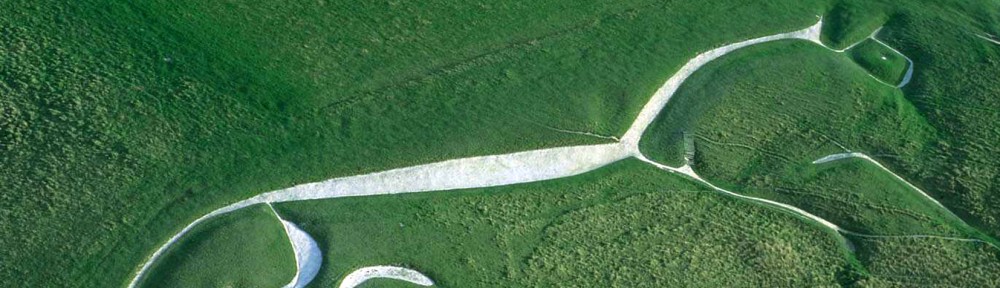
It’s been a while since I wrote a substantial blog for History on Horseback, and what’s inspired me to produce one now is the amount of commentary that’s going round on Britain’s native semi-feral herds of ponies. A lot of what I’m reading is not based on substantial knowledge of the herds, and some of it is not helpful at all.
To begin with some very deep history: if we go back to the days of half a million years ago, when Britain was still part of the Eurasian continent, just separated by the low-lying area that came to be known as Doggerland, hominids (upright apes like us) and animals made a seasonal migration to Britain in the northern hemisphere’s summer. In winter they retreated back to warmer climates in the south. It’s still a natural movement in various parts of the world, both of wild animals and domesticated animals being herded; and of course we witness it through the annual migrations of birds such as swallows, which are still able to make the journey, unlike animals, as the larger mammals would now have to do a cross-Channel swim to achieve it. Plus we’ve mostly destroyed their habitat and hunted many species to the point of extinction anyway.
But half a million years ago, that wasn’t an issue, and all kinds of animals made the annual migration, including horses, deer, and bison. Vast, and I mean VAST flowing herds of animals, followed by hominid hunters with stone tools, who slaughtered and ate them at locations such as what’s now Boxgrove on the south coast of England. There were so many equine bones discovered at one site it simply became known to the archaeologists who investigated it as the “Horse Butchery Site”. There was also a Rhino Butchery Site! Yes, really. There were mammoths too, and hyenas, all holidaying where Brits do now, saying the hyena equivalent of “turned out nice, couldn’t half fancy a bit of nice rump steak”. (You can read all about life in those days in Fairweather Eden by Michael Pitts and Mark Roberts. Worth getting hold of a copy if only for the superb reconstruction of rhino butchery in image 1, as well as the excellent graph showing just how often we’ve dipped and swung into Ice Ages and periods between.)
And that would have carried on season after season, with intermittent glacial periods when northern holidaying with the travelling buffet-on-legs wasn’t possible (sometimes the hominids were the buffet, if they encountered bears or big cats), if it hadn’t been for two things.
The first thing was that at least one Major Geological Incident called the Storegga Slide, around 8,500 years ago, caused an inundation that left Doggerland permanently under water. Or perhaps it was simply naturally rising sea levels at the end of the Ice Age. Evidence of previous occupation by humans and animals still lies there, just a few feet below the surface of the North Sea in places. No more crossing Doggerland to take a break in the summer, munch on the lush grass and browse on the trees of what’s now the island of Britain, or eat the grazers of grass and browsers of trees and bushes. Hominids and non-hominid animals stood on the further shore, much like passengers awaiting their delayed flight at Heathrow, except this flight was never going to arrive.
The second thing was that hominids, no longer happy to stick with outdated stone tools (still using that old thing? OK, Boomer) decided that they could do even better than partake of nature’s buffet, and set off down the road marked progress, ultimately taking some of the animals along with them as “domesticated species”. The hominids were also cunningly using their brains to develop new ways to cross the Channel, looking speculatively at the birds winging their way to the shore that now seemed forbidden to the hominids.
This is where the story of “Britain’s ponies” really begins, with the separation of part of continental Europe that would subsequently by historical accident or incident come to be known as “Britain”.
The story begins, as many good stories do, with a clash of beliefs. At its core is this question: did some small equines, ponies as we would now know them, survive the last glacial period and subsequent geological upheaval, to become the oldest equines on Britain? Did their ancestors live on the island before the last glacial episode? The principal candidates for this theory have long been the Exmoor ponies, with their distinctive coat colours and phenotype, and what are known as mealy-coloured muzzles and eyes, sometimes called toad eyes. Researchers have drawn comparisons with the horses in palaeolithic imagery.
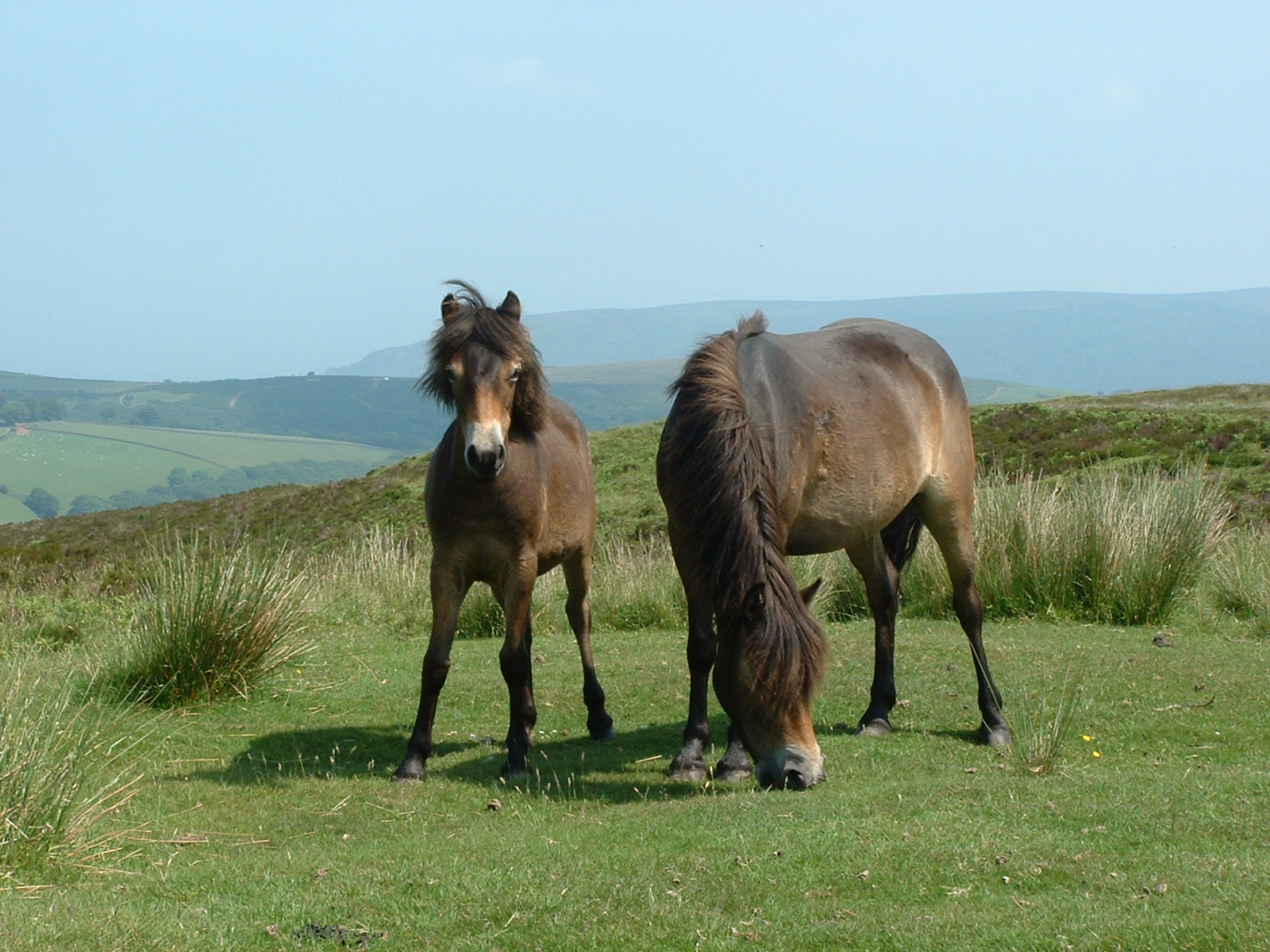
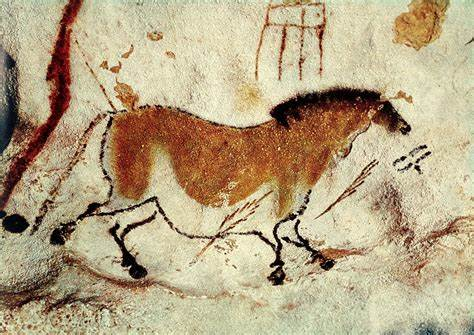
Can coat colour, and particularly genes related to dun colouring assist in identifying the antiquity of equines? Researchers have attempted to discover the genetic factors related to the coats typical of Exmoors and other apparently similar types. In 2010, for instance, Michael Cieslak, Monika Reißmann, and Arne Ludwig explored aspects of this in an academic paper titled “Examination of melanophilin as a candidate gene for the equine dun phenotype”, noting that “The dun coloration is probably the wild phenotype in horses depending on its occurrence in Przewalski horses as well as in some primitive horse breeds (e.g. Exmoor Pony, Konik, Icelandic Horses, Norwegian Fjords, Sorraia)”. They concluded that “Although the melanophilin gene is responsible for dilution phenotypes in human, mice, and other domesticated species, the detected SNPs of this investigation revealed no facts showing that there is any obvious association with the dun phenotype”. And so on.
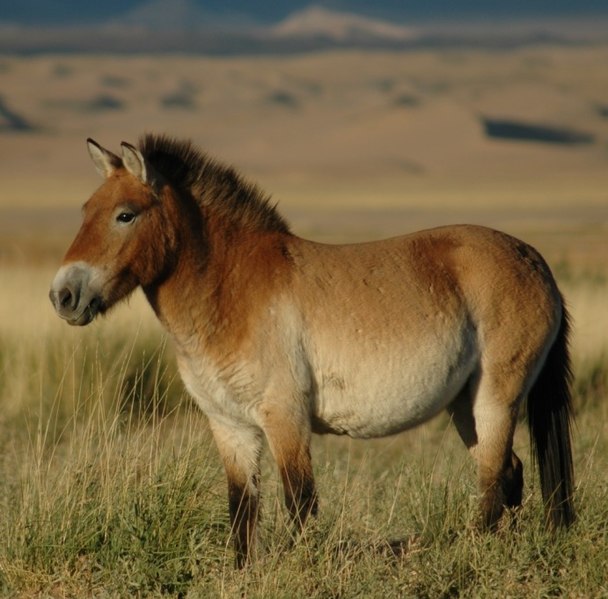
At that time, the Przewalski horses (also known as Takhis) were believed to be the only truly wild horses left in the world. Then, in 2019 a large group of researchers made an earth-shattering claim based on further DNA investigations: the Przewalski Horses were not wild at all, but the descendants of an early “domestication event” (known as DOM1) which had begun and then ceased. (Fages, Orlando, Outram et al, “Tracking Five Millennia of Horse Management with Extensive Ancient Genome Time Series”.) Where does that leave attempts to claim antiquity based on phenotype, colouring, and mealy muzzles? Good question. Where, indeed.
With the horses that had previously been believed to be the only truly wild ones in the world exposed as actually being the feral descendants of the first domestication event (this conclusion is contested in some quarters), that meant that all the horses in the world, apart from the Takhis, were in fact the domesticated or feral descendants of the later, second domestication event (DOM2), including our island ponies. Currently we still have no firm data that would enable us to comment on the antiquity of the Exmoor with complete confidence. They are, however, popular for conservation grazing schemes.
At this point it should be pointed out that “wild” horses continued to live in the landscape of Eurasia after horses were domesticated on the Eurasian steppe lands ca. 2500 BCE. And so the domesticated horses continued to breed with what were originally “wild” horses. The wild, or increasingly semi-feral herds consisting of a mix of domesticated and wild horse genes continued to proliferate in the landscape right into modern times, and their descendants still exist today on the island of Britain. They have done so since the introduction of the domesticated horse into Britain at some point possibly as early as the third millennium BCE.
What is a semi-feral herd? Semi-feral herds are those that mostly live a “natural” life (ie, with free access to grazing, natural mating and rearing of foals, and so on) but are periodically attended to by humans, usually in the form of drifts or “round-ups”. During these, the small horses (there’s a whole narrative to the word “pony”, but I’m not doing that today) are brought in, checked, given veterinary treatment if they need it, and some are sold. There may be substantial management by humans, especially regarding which stallions have access to which mares.
This system of equine management has been going on for centuries, if not millennia, across Eurasia. They were once simply everywhere in the landscape, these semi-feral herds. Our knowledge is hampered as to how long this has been going on in Britain by a lack of documentary evidence relating to the herds prior to medieval times. However, there’s decent evidence from later medieval times, of which I cite just a few examples:
- In the days of King William I of Scotland (aka William the Lion, 1165-1214) the king made reference to grants of money and land to the Priory Church of St Andrews in the years between 1165 and 1172: Et decimam de omnibus meis siluestribus equabus de Fif de Forthrif. Et ut habeant per totam terram meam theloneum quietum de cunctis rebus qua mercati fuerint ad propria eorum necessaria. [A tenth of all my wild mares from Fife and Forthrif. And throughout the whole of my realm, that they may have the ?toll? of a contrite spirit, all the things of the market which are proper and necessary to them.] In other words, meis silvestribus equabus were a note-worthy part of the donation.
- In Chaucer’s bawdy story of the miller and his daughter, told by the reeve, the miller releases a borrowed stallion (taken from two clerks who were loaned it by their superior), into the Cambridgeshire fen, where he runs off to join the wild mares, whinnying “Wehee!” as he goes.
- References to Equi/Equis Silvestris and similar phrases (wild horses) occurs in places where today there are semi-feral herds such as Dartmoor and the New Forest.
- The much-quoted law of Henry VIII dating to 1542 in which he wanted to improve the “breade” of horses in England by controlling and culling the smaller horses that were living all over England actually turns out to have been a very ineffective piece of legislation. It was not enacted properly, and did not apply to large areas of the country. The whole of the north of England was exempt, for instance.
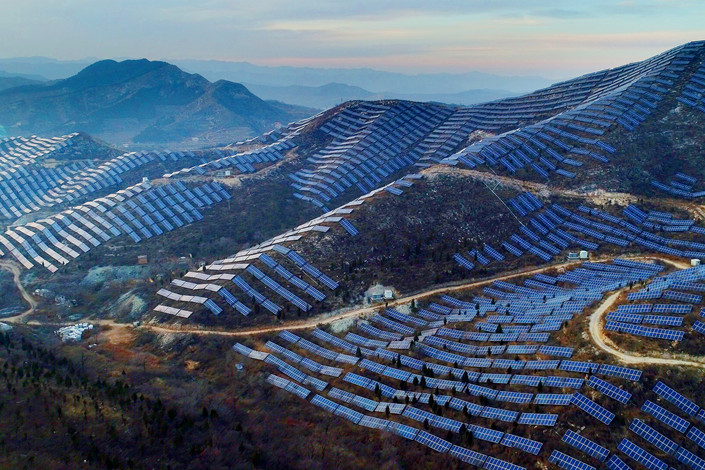
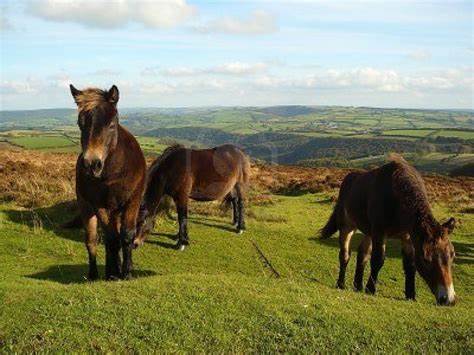
The semi-feral herds that remain on the island today, on Dartmoor, Exmoor, in the hills of Wales and the Highlands and Islands of Scotland, as well as the Cumbrian Fells, and New Forest, are but a tiny remnant of the herds that once roamed here, from at least half a million years ago until early modern times. They are now under threat because we want the land for other purposes, pure and simple. They eat the grass! Disgusting! Put up a solar array instead. (Unless the ponies are some of the lucky ones that have been recruited for conservation grazing schemes.)
Here’s a picture of a hillside covered in solar panels, and another hillside with ponies on it. I know which I prefer, and I know which I think is more environmentally sound.
Conclusion: small equines (of the type that we now call ponies) have existed on the bit of land now known as Britain even longer than you and I, as modern humans, have. They have as much right as you or I to be here, if not more. Although most modern semi-feral herds have been very much influenced by decisions made by human breeders, some of the genes in those semi-feral herds may be of great antiquity. So here’s the question: does it really matter how old those genes are? Does it?
I’m going to do a part 2 that will look at the progress of some of Britain’s semi-feral pony herds over the last century or so, as they stopped simply being semi-feral herds and became “breeds”.
Miriam A Bibby 21.11.23.
 historyonhorseback