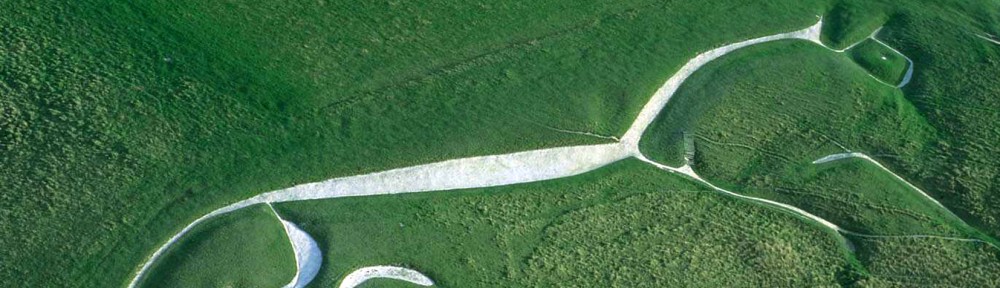
In parts 1-3 we established that ponies have been on the island of Britain since – well, since it wasn’t actually an island, but still attached to the continent. They were, and are, fellow passengers through time. People have been living with them, making use of them, observing them, worshipping them, eating them (though not recently), and also getting bloody annoyed with them for centuries, if not millennia.
The latest lot of people to get bloody annoyed with ponies can frequently be found among some promoters of rewilding, who don’t seem to like any grazing animals at all, and no doubt think that the fact sheep and goats have horns prove that they are Satan’s spawn. I sometimes feel as though I’m living in a neo-Puritan age.
I find it increasingly hard to relate to anyone who will point out the mote in Mr or Ms Sheep’s eye but not see any beams in those belonging to circa eight billion delinquent car-driving, house-dwelling, phone-fiddling, plane-flying humans on the planet. Granted, sheep are not “indigenous” to Britain, but goats might be. Domesticated sheep arrived from West Asia (along with cereal growing, no doubt) in the late Neolithic. Then came the vegetables. I’m pretty sure the sheep would have nibbled their way here eventually if Britain had remained part of the continental mass. As it was they most likely arrived along with humans in – ahem! – small boats. The vegetables would never have made it without human assistance.
We also established in previous parts of the series that I like vegetables, but I am aware of their limitations and issues when it comes to land use. Also, that deliberately growing vegetables is an entirely human thing and not always to the benefit of fellow passengers on the planet (though ponies do like an organically-grown carrot or two, and are happy to provide lots of muck in which to grow them, and other vegetables).
It’s clear that right onto the cusp of the industrial age there were still plenty of semi-feral herds, the descendants of domesticated and wild horses, across Eurasia. And that some still exist right here on the island of Britain. As land was enclosed, and then drained and/or industrialised, the big open spaces in which the herds had roamed shrank and the ponies became confined to the less fertile uplands and areas of mixed heath and trees such as the New Forest. Ponies helped with all those processes of enclosure, land improvement, and industrialisation. In other words, they were recruited without contracts into projects that would eventually limit their own environment and choices.
Right into the early twentieth century Britain’s ponies were still seen as a useful resource, an intrinsic part of the environment, and just something that was, well, there. Always had been. Apart from the small and hardy Galloway horses of southwest Scotland, once very famous, which had been lost, or rather incorporated into other breeds in a major round of “improvement” in the late eighteenth century.
Then something happened, or rather a series of unfortunate (or fortunate, however you look at it) events occurred.
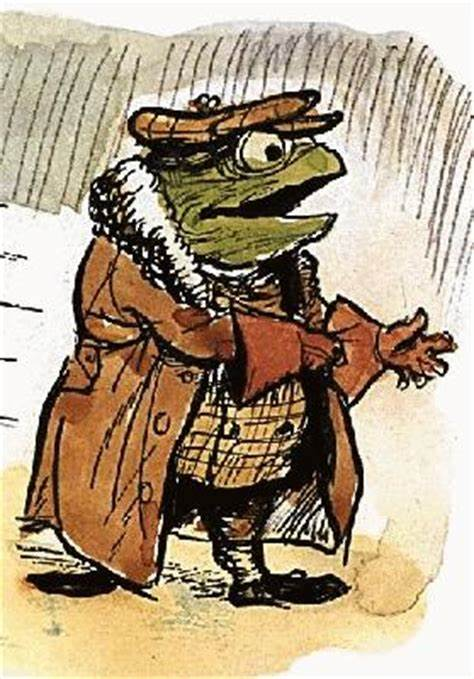
The most obvious one was the arrival of the car. Poop poop! I’ve always thought that the chapter in Wind in the Willows describing how a car forces off the road the canary-coloured horse-drawn caravan, in which our heroes Ratty, Mole, and Toad are talking a leisurely break, reflected a pivotal moment in reality as well as fiction. Toad becomes an instant car fanatic as he sits in the wake of the speeding vehicle murmuring “Poop poop!” and “Oh joy, oh bliss!”. He thinks with pleasure of all the “horrid canary-coloured” caravans he will in his turn force from the roads. Meanwhile, Ratty and Mole, like all good horsepeople, are concerned for the safety and welfare of the horse.
Another major change was the arrival of the concept of “breeds” of horse, a long historical process that I’m not going to discuss in great detail here as it would lead to there being approximately 97 parts to this series. However, this had major implications for equines as people began to define what a horse or pony breed was, what it should look like, how tall it should be, even what colour it should be, and what its history and purposes were. The major difference between the nineteenth century attempt to do this and that of earlier centuries was that now people were to have “breed standards” and “stud books”. Many of those stud books contained terms along the lines of “any solid colour, but not piebald or skewbald”.
Today, it’s quite normal to see piebald and skewbald Dartmoor ponies, and to hear them described as a significant part of Dartmoor’s heritage. However, this was certainly not the case sixty years ago, in the days of Jenny Loriston-Clarke’s famous Shilstone Rocks Stud of Dartmoor ponies, or even as recently as forty years ago. Here’s a quote on Dartmoor Ponies from the breed description in Jane Kidd’s edition of The New Observer’s Book of Horses and Ponies (1984):
“The ponies remain unhandled unless rounded-up for sale, and few mares and fewer stallions are ever handled except for breeding purposes.” Right, this is in line with the comments in my previous blog on Britain’s semi-feral herds, though we may wonder at why some mares and stallions need to be handled for “breeding purposes”. They can probably manage fine themselves, but that might lead to the “wrong kind of ponies”, which leads nicely into the next paragraph.
Kidd continues: “The continuing existence in its natural habitat of the pure Dartmoor has for many years been in serious jeopardy. In the early twentieth century, in order to meet the need for very small pit ponies, some moormen indiscriminately introduced Shetland stallions to the moors. The result was an indifferent and sometimes degenerate Dartmoor-Shetland cross, which multiplied at the cost of the true Dartmoor. However, the Dartmoor Pony Society has made strenuous efforts to eliminate this regression, introducing stringent upgrading registers. With the help of a few individual breeders, it has managed to safeguard the purity of the breed.”
And what is “the purity of the breed”? Among other parameters, “Not exceeding 12.2 hands. Bay, black, or brown preferred, but no colour bar except skewbalds and piebalds. Excessive white is discouraged.”
This is borne out by Caroline Silver’s near contemporary Horses of the World publication (1978): “Bay, black, and brown are preferred. Odd colours such as piebald and skewbald exist, but they are not recognised by the breed society”. She also refers to the “small, aristocratic heads” of the Dartmoors, small heads being something of an obsession for some “improvers”, especially those who like Lady Wentworth argued that the Arab(ian) horse was the great improver, with its most beautiful head (in her opinion).
In other words, the ponies that are now held to be valuable, and valued, for their own sakes, including piebald and skewbald ponies on Dartmoor, would forty years ago have had their pony epaulettes torn off and been drummed out of the Dartmoor Pony messroom. If you saw a pony with particular characteristics in the wilds of Dartmoor, it was a Dartmoor pony. And the piebalds and skewbalds, maybe with Shetland ancestry? We don’t talk about those.
I mean honestly. Those Shetlands coming down here with their “Hoots!” and “Jings!”, luring our precious mares to get up to no good with a “Ye’re a bonnie wee lassie and it’s a braw, bricht, moonlicht nicht the nicht”. Note that the people who actually kept and managed and needed the herds, the upland farmers and miners, weren’t at all bothered about that. It was the (now mainly middle class) upholders of ponies as heritage who were flustered by those randy little Shetlanders.
Caroline Silver also provides a quote from William Youatt, nineteenth century author of many texts on animal husbandry and breeds: “There is a breed of ponies much in request in that vicinity [Dartmoor], being sure-footed and hardy, and admirably calculated to scramble over the rough roads and dreary wilds of that mountainous district. The Dartmoor pony is larger than the Exmoor, and if possible, uglier. He exists there almost in a state of nature. The late Captain Colgrave, governor of the prison, had a great desire to possess one of them of somewhat superior figure than the others, and having several men to assist him, they separated it from the herd. They drove it on some rocks on the side of a tor. A man followed on horseback, while the captain stood below, watching the chase. The little animal, being driven into a corner, leaped completely over man and horse and escaped”.
“They’re good enough as they are.“ “They need improving!” “They need to be managed!” “They need to be left alone.” And so on. The debates continue to this day, with the horses in the middle of this tug-of-war, completely oblivious to what goes on in human psychology until the day arrives where it affects them without any shade of doubt via a shot from a helicopter, or the horse box that takes them to the meatman. Sadly, the major debate today regarding semi-feral equines, not just in Britain, appears to be between two new camps: “Do we need them at all?” and “They are our heritage”, which may in the end prove to be far more problematic than the conflict between breed improvers and standardisers, and pragmatists like the moormen. The latter thought nothing of changing their “heritage” with Shetland stallions in order to meet market needs. Perhaps horses would prefer it if we went back to the Boxgrove days, when they knew hominids were predators, and they were prey. At least it was clear where they stood.
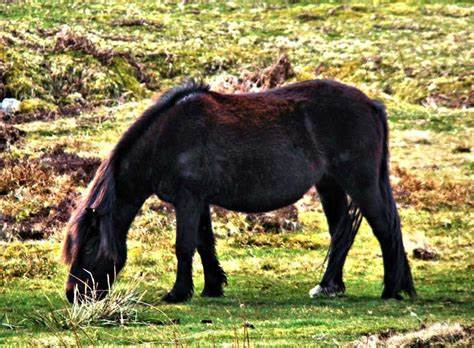
While I was putting this blog together, something was happening. Gareth Wyn Jones, a Welsh (Cymric) farmer with a big social media profile (and a lot of followers, not all of whom are supporters) was bringing down a struggling foal from the mountains in the teeth of a howling storm, to try to save its life. That’s what he and his ancestors have been doing for centuries, and will carry on doing for as long as they can. Sadly the foal died despite his best effort to save it. I doubt if he met many of his critics up there on the mountains in the face of Storm Isha. You can watch his efforts to save it here:

Miriam A Bibby 2024
 historyonhorseback